


The Low-Altitude Economy Race: How Composite Materials Support Mass Production

October 09, 2026
Return To List

The low-altitude economy is entering a critical stage of industrial development. Aircraft such as industrial drones and eVTOL vehicles are moving from prototype development toward commercial mass production.

Lightweight composite materials, including carbon fiber, glass fiber prepregs, and composite mesh fabrics, play a key role in reducing aircraft weight and improving endurance.

Composite Material Cutting Solutions for Low-Altitude Aircraft

While much of the industry’s attention focuses on flight control and propulsion systems, composite material cutting is often overlooked. Developing a prototype may be relatively straightforward, but achieving stable and efficient mass production presents a much greater challenge.

01 Challenges in Scaling Up Low-Altitude Manufacturing

Insufficient cutting precision can lead to burrs and delamination in composite materials, directly affecting subsequent assembly. As aircraft models evolve rapidly and production orders involve multiple varieties in small batches, traditional die-based cutting requires costly tooling changes and offers limited flexibility.

Meanwhile, high-performance composite materials are expensive, making material waste a significant cost concern. Manual nesting further reduces material utilization, adding to overall production costs.

Composite Material Cutting Solutions for Low-Altitude Aircraft

02 Meeting the Challenges of Composite Material Cutting

To meet the demands of large-scale composite material processing, the KC1625TT-SD Intelligent Oscillating Knife Cutter, equipped with dual asynchronous cutting heads, offers a solution for multi-layer cutting of regular materials.

Designed for high-volume production, the system features an Intelligent Material-Saving Nesting System that maximizes material utilization and helps control production costs. Its dual asynchronous cutting heads increase output capacity while maintaining production flexibility, meeting the demands of mass production.

The system also integrates multi-layer cutting and punching to meet the processing requirements of various composite materials.
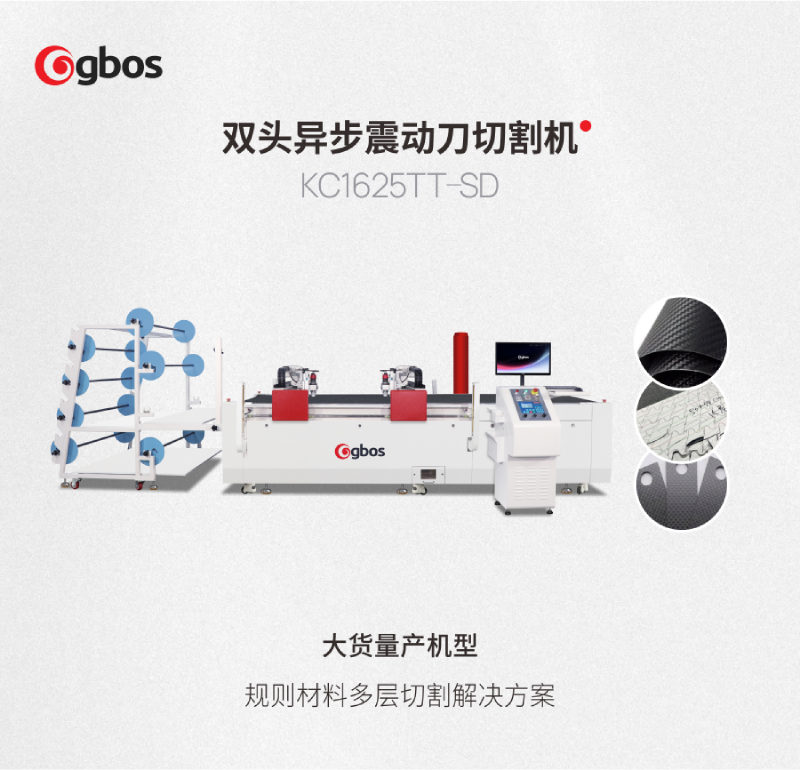
KC1625TT-SD Intelligent Oscillating Knife Cutter

An optional projection preview positioning system projects nesting layouts directly onto the material surface, giving operators a clear visual reference to help them understand the layout and monitor the cutting process.

In addition, the multi-layer material rack features a high load-bearing capacity, allowing multiple material rolls to be suspended simultaneously. This reduces the need for frequent manual material loading, helping improve production automation and overall efficiency.

03 Intelligent Manufacturing Supports the Growth of the Low-Altitude Economy

Competition in the low-altitude economy depends not on materials or equipment alone, but on collaboration across the entire industrial chain.

To maintain product quality and control production costs, enterprises need to address manufacturing bottlenecks throughout their supply chains.

Composite Material Cutting Solutions for Low-Altitude Aircraft

GBOS is committed to leveraging digital cutting technology to address composite material cutting challenges in low-altitude aircraft manufacturing, connecting the production process from design drawings to mass production and supporting the industry’s continued development.

Recommended news
  • The low-altitude economy is entering a critical stage of industrial development. Aircraft such as industrial drones and eVTOL vehicles are moving from prototype development toward commercial mass production. Lightweight composite materials, including carbon fiber, glass fiber prepregs, and composite mesh fabrics, play a key role in reducing aircraft weight and improving endurance. While much of the industry’s attention focuses on flight control and propulsion systems, composite material cutting is often overlooked. Developing a prototype may be relatively straightforward, but achieving stable and efficient mass production presents a much greater challenge. 01 Challenges in Scaling Up Low-Altitude Manufacturing Insufficient cutting precision can lead to burrs and delamination in composite materials, directly affecting subsequent assembly. As aircraft models evolve rapidly and production orders involve multiple varieties in small batches, traditional die-based cutting requires costly tooling changes and offers limited flexibility. Meanwhile, high-performance composite materials are expensive, making material waste a significant cost concern. Manual nesting further reduces material utilization, adding to overall production costs. 02 Meeting the Challenges of Composite Material Cutting To meet the demands of large-scale composite material processing, the KC1625TT-SD Intelligent Oscillating Knife Cutter, equipped with dual asynchronous cutting heads, offers a solution for multi-layer cutting of regular materials....
    Pub Date: Oct 09, 2026
  • As automotive interior design continues to evolve, dual-arc 3D curved surfaces have become a mainstream styling feature for headliners, typically combining suede-like soft upholstery with curved composite substrates. With rapid model iteration and increasing demand for customized orders, automakers require increasingly high levels of precision, acoustic transparency, and production efficiency for microphone hole cutting and irregular contour trimming on headliners. However, conventional universal processing equipment often lacks the adaptability required for these applications. Outdated processing methods make it difficult to meet the stringent requirements of 3D interior manufacturing, creating a critical bottleneck for quality improvement and productivity enhancement among many automotive interior suppliers. 1. Key Challenges in 3D Headliner Cutting The large 3D curvature and soft, multi-layer composite structure of automotive headliners present significant challenges for conventional cutting methods. Standard flat-bed cutting systems have clear limitations, as they cannot perform conformal cutting along complex curved surfaces. Traditional processing methods also rely heavily on dedicated tooling. High mold development costs and long lead times limit production flexibility, while even minor product changes or new-model launches may require new molds. In addition, repeated fixturing and repositioning can easily lead to misaligned microphone holes and dimensional deviations. These issues can affect headliner assembly...
    Pub Date: Sep 14, 2026
Book a virtual demo to explore our digital cutting and process solutions.
Request an Online or On-Site Demo
Get Your Manufacturing & Process Solution
Contact Now
Customization
Customized products
Find the machine that suits you best
Select from the options below to find what you need faster.
Choose your application(s) from the list.
NEXT STEP
Do you process roll or sheet materials?
PRE STEP
NEXT STEP
What is the max length and width of your material?
Length
Width
PRE STEP
NEXT STEP
Here are the standard models for you:
PRE STEP