


As automotive interior design continues to evolve, dual-arc 3D curved surfaces have become a mainstream styling feature for headliners, typically combining suede-like soft upholstery with curved composite substrates.
With rapid model iteration and increasing demand for customized orders, automakers require increasingly high levels of precision, acoustic transparency, and production efficiency for microphone hole cutting and irregular contour trimming on headliners.
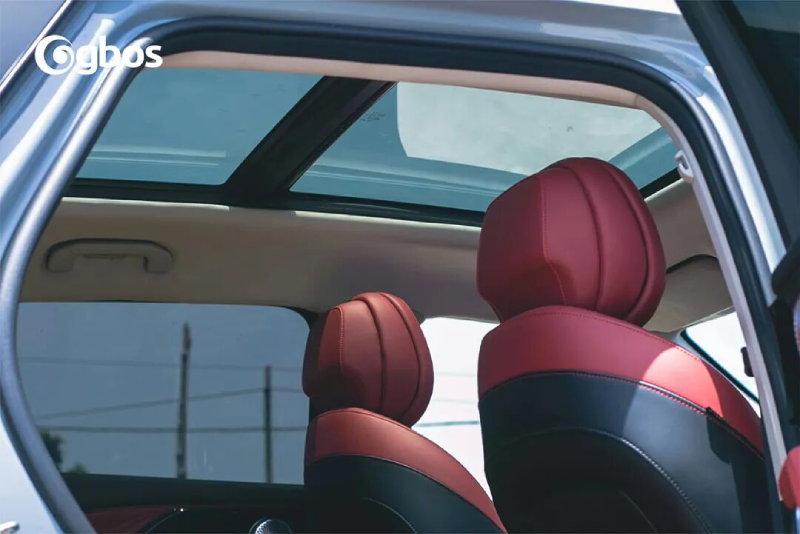
However, conventional universal processing equipment often lacks the adaptability required for these applications. Outdated processing methods make it difficult to meet the stringent requirements of 3D interior manufacturing, creating a critical bottleneck for quality improvement and productivity enhancement among many automotive interior suppliers.
1. Key Challenges in 3D Headliner Cutting
The large 3D curvature and soft, multi-layer composite structure of automotive headliners present significant challenges for conventional cutting methods. Standard flat-bed cutting systems have clear limitations, as they cannot perform conformal cutting along complex curved surfaces.
Traditional processing methods also rely heavily on dedicated tooling. High mold development costs and long lead times limit production flexibility, while even minor product changes or new-model launches may require new molds.
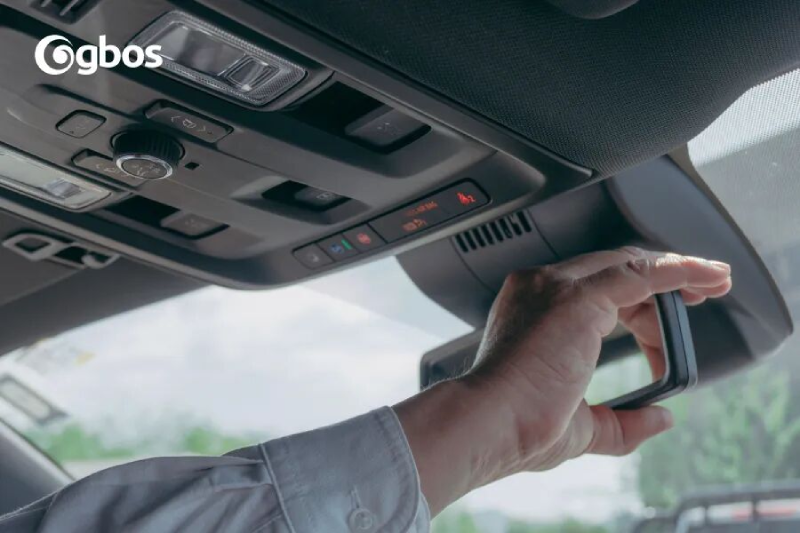
In addition, repeated fixturing and repositioning can easily lead to misaligned microphone holes and dimensional deviations. These issues can affect headliner assembly accuracy and acoustic performance, while also reducing yield and production capacity. As a result, it becomes more difficult to reliably meet high-volume production demands.
2. Empowering Automotive Headliner Processing
Designed specifically for automotive headliner production, GBOS introduces the GN3115-3D Five-Axis 3D Laser Cutter.
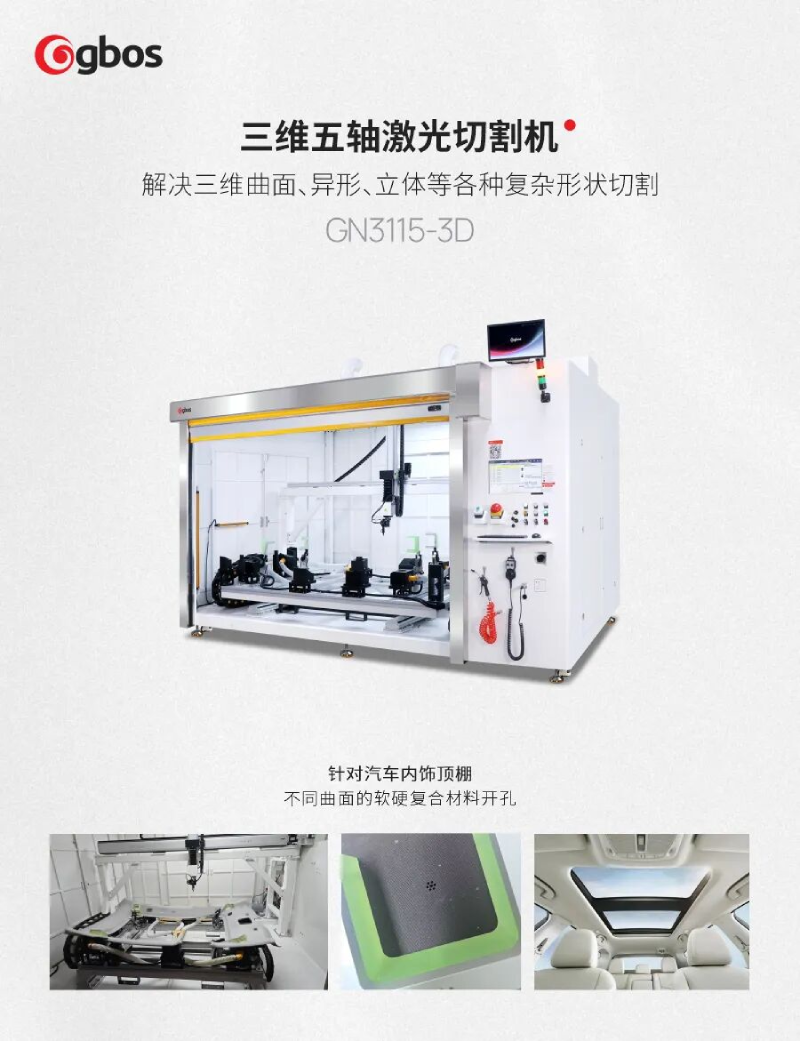
With a dedicated structural design, the compact machine can be seamlessly integrated into existing OEM production lines. It offers quick commissioning, fast ramp-up, stable operation, and a low failure rate, helping maintain consistent quality and production efficiency in mass production while addressing the core challenges of 3D headliner cutting.
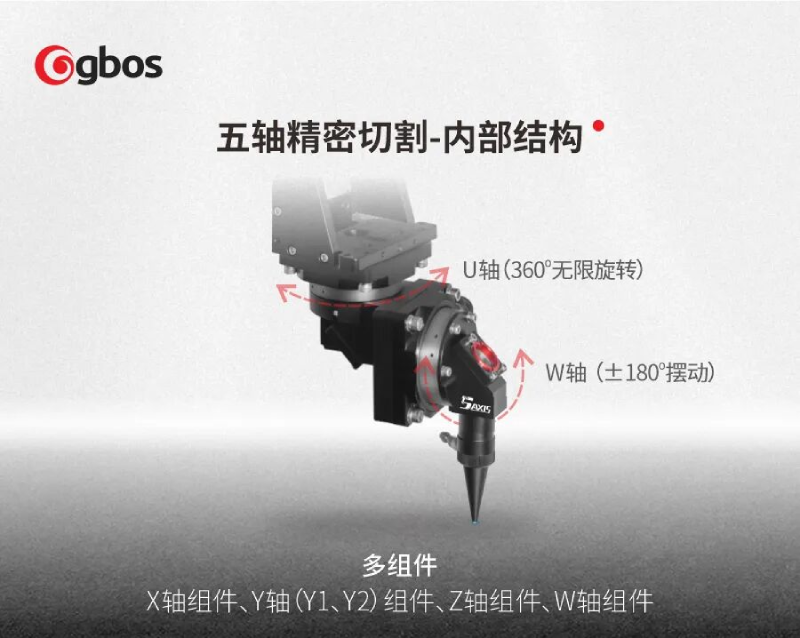
Equipped with proven five-axis 3D motion control technology, the GN3115-3D overcomes the limitations of traditional planar processing. It enables true conformal cutting across dual-curved headliner surfaces and irregular hole patterns, completing the required operations in a single setup. This eliminates the need for molds and reduces positioning errors, helping achieve high cutting precision and acoustic transparency while supporting both fine-detail prototyping and high-volume production.
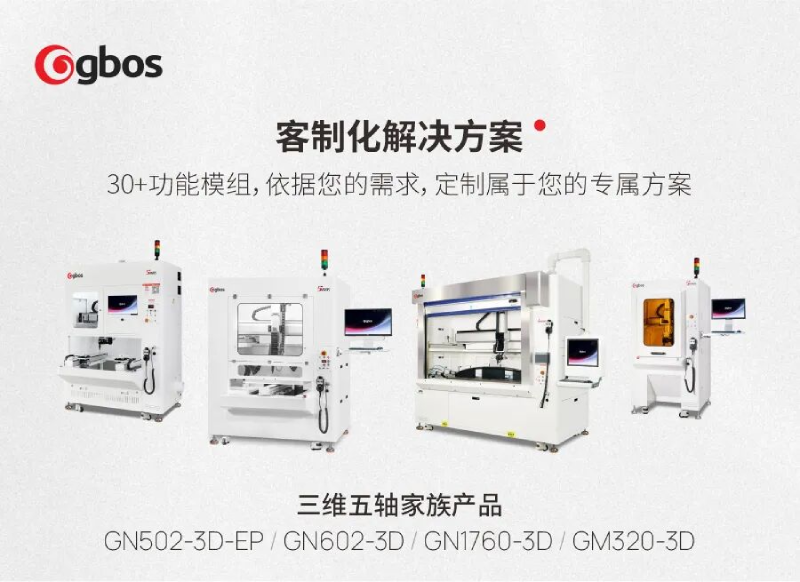
Furthermore, GBOS provides fully customized solutions. Device functional modules, operating parameters, and processing modes can be flexibly configured according to each client’s specific workpiece dimensions, material properties, process requirements, line integration conditions, and order profiles. This enables highly adaptable, end-to-end intelligent manufacturing solutions for diverse and evolving production needs.
3. Driving Automaker Breakthroughs Through Innovative Smart Manufacturing
As competition intensifies across the automotive industry, standardized and generic equipment is no longer sufficient to support sustainable enterprise growth. High-precision, highly flexible, and intelligently customized processing solutions are becoming increasingly important for industrial upgrading.

GBOS remains committed to the R&D and real-world application of advanced laser equipment and integrated smart manufacturing services. By continuously optimizing customized intelligent solutions, GBOS helps automotive interior and exterior manufacturers overcome production bottlenecks, reduce costs, improve quality, increase efficiency, steadily expand production capacity, strengthen core competitiveness, and capture emerging opportunities in the evolving automotive industry.
 Address: No. 1 Liansheng Road, Hongmei Town, Dongguan City, Guangdong Province. CN
  Tel: +86 769 88990609
  Fax: +86 769 88990677
  Email: