


The low-altitude economy is entering a critical stage of industrial development. Aircraft such as industrial drones and eVTOL vehicles are moving from prototype development toward commercial mass production.
Lightweight composite materials, including carbon fiber, glass fiber prepregs, and composite mesh fabrics, play a key role in reducing aircraft weight and improving endurance.

While much of the industry’s attention focuses on flight control and propulsion systems, composite material cutting is often overlooked. Developing a prototype may be relatively straightforward, but achieving stable and efficient mass production presents a much greater challenge.
01 Challenges in Scaling Up Low-Altitude Manufacturing
Insufficient cutting precision can lead to burrs and delamination in composite materials, directly affecting subsequent assembly. As aircraft models evolve rapidly and production orders involve multiple varieties in small batches, traditional die-based cutting requires costly tooling changes and offers limited flexibility.
Meanwhile, high-performance composite materials are expensive, making material waste a significant cost concern. Manual nesting further reduces material utilization, adding to overall production costs.

02 Meeting the Challenges of Composite Material Cutting
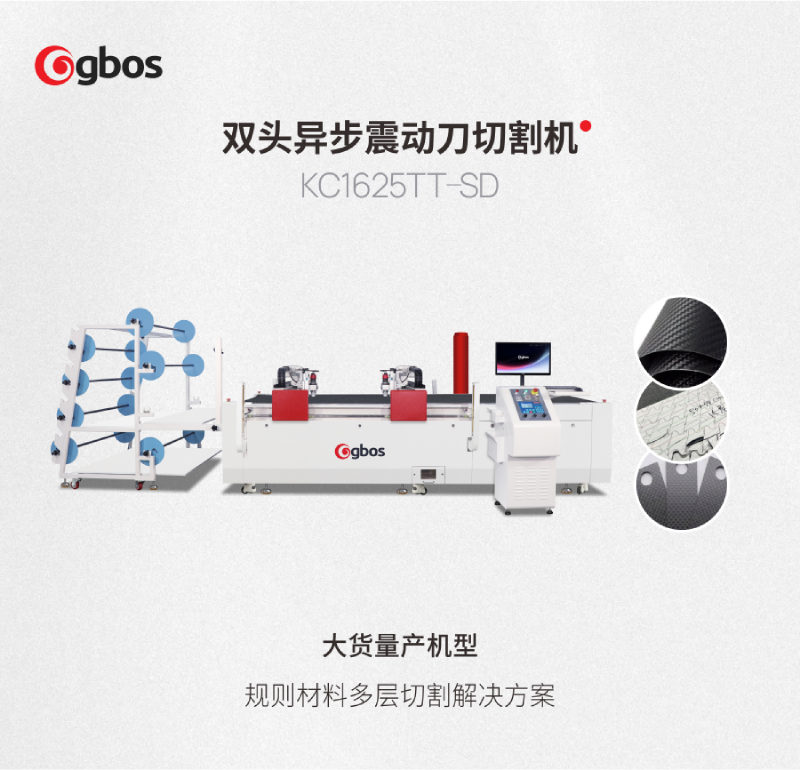
To meet the demands of large-scale composite material processing, the KC1625TT-SD Intelligent Oscillating Knife Cutter, equipped with dual asynchronous cutting heads, offers a solution for multi-layer cutting of regular materials.
Designed for high-volume production, the system features an Intelligent Material-Saving Nesting System that maximizes material utilization and helps control production costs. Its dual asynchronous cutting heads increase output capacity while maintaining production flexibility, meeting the demands of mass production.
The system also integrates multi-layer cutting and punching to meet the processing requirements of various composite materials.
An optional projection preview positioning system projects nesting layouts directly onto the material surface, giving operators a clear visual reference to help them understand the layout and monitor the cutting process.
In addition, the multi-layer material rack features a high load-bearing capacity, allowing multiple material rolls to be suspended simultaneously. This reduces the need for frequent manual material loading, helping improve production automation and overall efficiency.
03 Intelligent Manufacturing Supports the Growth of the Low-Altitude Economy
Competition in the low-altitude economy depends not on materials or equipment alone, but on collaboration across the entire industrial chain.
To maintain product quality and control production costs, enterprises need to address manufacturing bottlenecks throughout their supply chains.

GBOS is committed to leveraging digital cutting technology to address composite material cutting challenges in low-altitude aircraft manufacturing, connecting the production process from design drawings to mass production and supporting the industry’s continued development.
 Adres: Liansheng Caddesi No. 1, Hongmei Kasabası, Dongguan Şehri, Guangdong Eyaleti. CN
  Tel: +86 769 88990609
  Faks: +86 769 88990677
  E-posta: