


As consumer expectations for detail and craftsmanship continue to rise across apparel, footwear, and fashion accessories, labels and trims have evolved far beyond simple brand identifiers. Exquisitely woven labels, multi-layered tags, and intricately printed ribbons now serve as tangible expressions of a brand’s identity, quality, and design sophistication.

Driven by this shift, market demand for labels and trims is becoming increasingly diversified, customized, and quality-oriented. Order volumes continue to grow, creating significant opportunities for processors. Yet many manufacturers are still caught in a difficult dilemma: increasing production capacity often comes at the expense of quality, while maintaining precision can limit throughput.
As the industry advances, legacy production methods and equipment limitations are becoming major obstacles to growth.
01 Industry Challenges: The Bottlenecks Behind Quality and Efficiency
Today’s label and trim manufacturers face several persistent challenges that directly impact profitability, scalability, and competitiveness.
Poor Adaptability to Complex Processing Requirements
Conventional cutting equipment often struggles to handle increasingly sophisticated trim designs. Frayed woven-label edges, damage to printed graphics, and deformation of irregular contours are common issues that compromise product appearance and lead to costly rework. These defects ultimately affect delivery schedules, product consistency, and brand reputation.
Same-Color Material Positioning Remains a Technical Barrier
Accurately cutting labels with minimal color contrast between printed patterns and substrate materials has long been one of the industry’s greatest challenges. Traditional vision systems frequently fail to distinguish subtle color differences, resulting in misalignment, inaccurate cuts, and low production yields—particularly in premium label applications where precision is non-negotiable.

Equipment Reliability and Maintenance Pressures
Many conventional machines lack the stability required for continuous, high-load operation. Frequent breakdowns, gradual accuracy drift, and shortened service life are common problems. Furthermore, complex mechanical structures and poor component standardization make maintenance time-consuming and expensive, often resulting in prolonged downtime and increased operating costs.
As customers demand shorter lead times and ever-higher precision, processors often find themselves trapped in a vicious cycle: winning orders is easy, but delivering them efficiently and profitably is increasingly difficult.
02 Precision-Engineered Solutions for End-to-End Processing Challenges
The industry’s evolving challenges require innovation-driven solutions. In today’s competitive environment, success depends not only on speed, but also on the seamless integration of precision, reliability, flexibility, and total cost efficiency.
To address issues such as deformation, same-color recognition, capacity constraints, and maintenance complexity, GBOS has introduced two flagship solutions—the “X LABEL180” and “GM1081SCCD”. Together, they provide intelligent manufacturing capabilities that support both high-volume production and premium customized applications.
X LABEL180: High-Speed All-in-One Platform for Maximum Throughput and Process Flexibility
As a benchmark solution for label cutting, the X LABEL180 directly addresses three major shortcomings of traditional equipment: limited productivity, insufficient process flexibility, and post-cut quality issues.
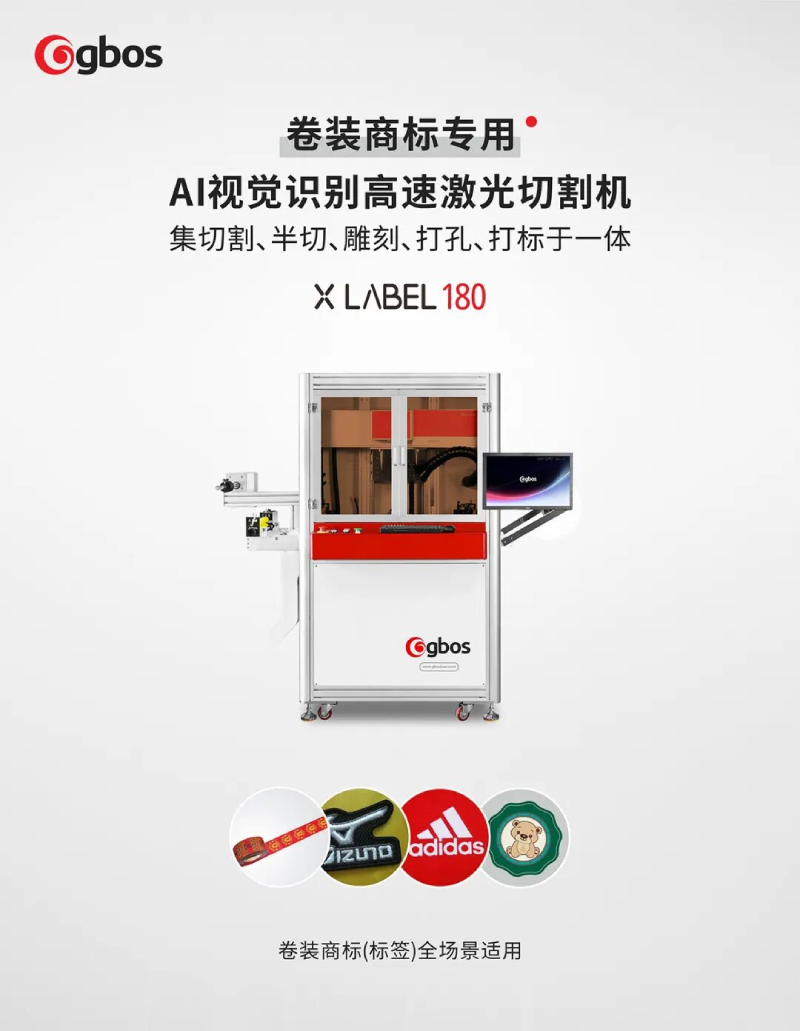
Its cutting efficiency significantly surpasses conventional machines. A single X LABEL180 can deliver the output of more than ten traditional units, dramatically reducing production lead times and enabling manufacturers to confidently handle large-volume orders.
Beyond productivity, the machine offers exceptional process versatility:
* Cumulative numbering and skip-code functions for full traceability and precise batch management;
* Longitudinal cutting, serrated cutting, and contour cutting for diverse label geometries and customized designs;
* Advanced processing capabilities, including hollowing, graphic engraving, and layered cutting, enabling complex multi-level labels and sophisticated printed ribbons without compromising quality.
These capabilities allow designers and manufacturers to push creative boundaries without being limited by equipment constraints.

To further protect product quality, the X LABEL180 incorporates a patented “4D Smoke Purification System”, preventing yellowing, blackening, and secondary contamination after cutting. Its fully enclosed processing area also ensures safer, cleaner, and contact-free production.
Designed for industrial durability, the machine minimizes breakdown frequency and substantially reduces maintenance complexity and operating costs, helping manufacturers achieve long-term, reliable performance.
GM1081SCCD: AI Vision Positioning 6.0 for Ultra-Precise Same-Color Cutting
While complex processing and productivity challenges affect the industry as a whole, high-precision same-color label cutting remains one of the most difficult technical barriers to overcome.
The GM1081SCCD was specifically developed to solve this challenge.
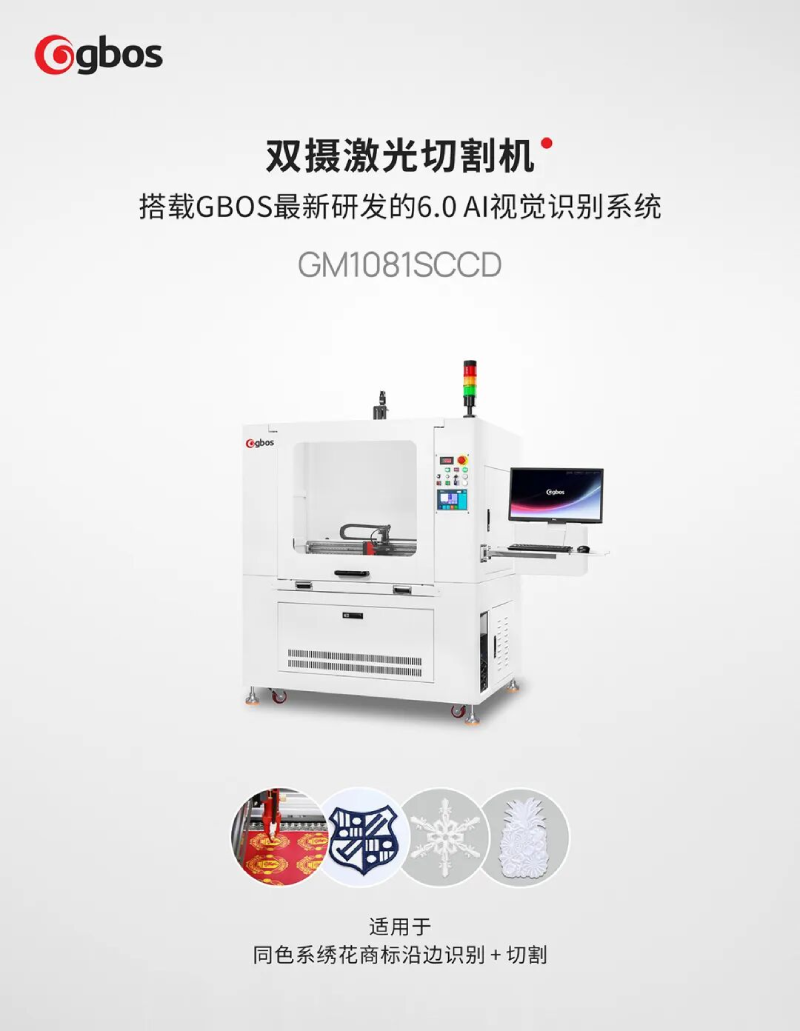
Powered by GBOS’s proprietary “AI VisionScan System 6.0”, the machine overcomes the limitations of conventional vision technologies. It can rapidly identify, accurately locate, and continuously track extremely subtle color differences between highly similar materials and printed patterns.
As a result, issues such as misregistration, uneven cutting, and high defect rates are effectively eliminated.
For the first time, manufacturers can achieve reliable, high-volume, high-precision processing of same-color labels at industrial scale—unlocking new opportunities in premium and differentiated production.

The GM1081SCCD is also engineered for long-term stability. Its core components are optimized for continuous high-load operation, delivering exceptional precision retention and extended service life. Combined with a standardized and simplified maintenance framework, routine servicing and component replacement become faster and easier, minimizing downtime and reducing technical barriers for operators.
The result is truly “high-precision, high-stability, and low-wear production”.
03 Continuous Innovation Creates Sustainable Competitive Advantage
Across the label and trim industry, competitive advantage is rapidly shifting from simple capacity expansion to refined quality-driven manufacturing.
Increasing consumer attention to detail, evolving brand aesthetics, and growing pressure for operational efficiency are accelerating the industry’s transition toward intelligent and precision-oriented production.

A truly advanced processing platform is not merely a productivity tool—it is a strategic asset that helps manufacturers avoid commoditization, strengthen market differentiation, and build long-term competitive resilience.
In this new era of transformation, breaking free from the limitations of legacy equipment and embracing cutting-edge technologies is the key to capturing future opportunities.
Because behind every meticulously crafted label lies not only a brand’s identity and value—but also the manufacturing excellence and technological capabilities of the processor who brings it to life.
 Address: No. 1 Liansheng Road, Hongmei Town, Dongguan City, Guangdong Province. CN
  Tel: +86 769 88990609
  Fax: +86 769 88990677
  Email: