


The footwear industry is undergoing a profound transformation. As consumer demand becomes increasingly personalized, manufacturers are faced with fragmented orders, shorter delivery cycles, and the need to process multiple materials simultaneously. Small-batch, high-mix production has become the new normal.
However, many factories still rely on manual or semi-automatic marking processes that struggle to keep up with today’s manufacturing demands.

Skilled marking operators are becoming harder to recruit, while labor costs continue to rise. Manual material positioning often leads to alignment errors, resulting in inconsistent marking quality and higher defect rates. Different production processes require different types of inks, forcing manufacturers to invest in multiple dedicated machines and separate production lines. At the same time, repetitive loading and unloading of cut parts consumes valuable labor hours, creating production bottlenecks during peak orders.
To overcome these challenges, manufacturers need more than incremental improvements—they need an integrated, intelligent marking solution.
01. Smart Inkjet Marking System: One Platform for Every Footwear Application
GBOS offers three specialized inkjet marking solutions that together support virtually every marking process used in footwear manufacturing. Whether producing standardized sports shoes or high-value specialty footwear, manufacturers can choose the configuration that best fits their production needs.
IP-GH1280-AT-2SCCD Industrial Ink-Cartridge Marking Machine
Designed for high-volume production, this model features a continuous ink-cartridge supply system compatible with fluorescent ink and permanent water-based ink.
Equipped with Dual VisionScan technology, it delivers a wider recognition range and greater positioning accuracy. Its large-capacity ink cartridges minimize replacement frequency, ensuring stable, uninterrupted production—ideal for athletic footwear, casual shoes, and other standardized products requiring high-speed, precision marking.
SP-GH1280-AT-SCCD Ink-Cartridge Inkjet Marking Machine
Offering greater ink flexibility, this model supports fluorescent ink as well as permanent water-based, neutral, and UV inks.
Compatible with leather, mesh fabrics, synthetic leather, and various upper materials, it is particularly suited for manufacturers producing multiple product lines or handling frequent order changes without requiring separate marking equipment.
LA-GN1280TT-AT-SCCD Dual-Head Asynchronous Syringe-Type Marking Machine
Built for specialized applications, this syringe-based system supports washable ink, heat-activated disappearing ink, fluorescent ink, and erasable ink.
Its dual-head asynchronous design allows simultaneous marking of different workpieces, making it ideal for heat-setting processes, safety footwear, ice skates, and other products requiring temporary or process-specific markings. The result is cleaner production with virtually no residual marks and significantly reduced scrap rates.
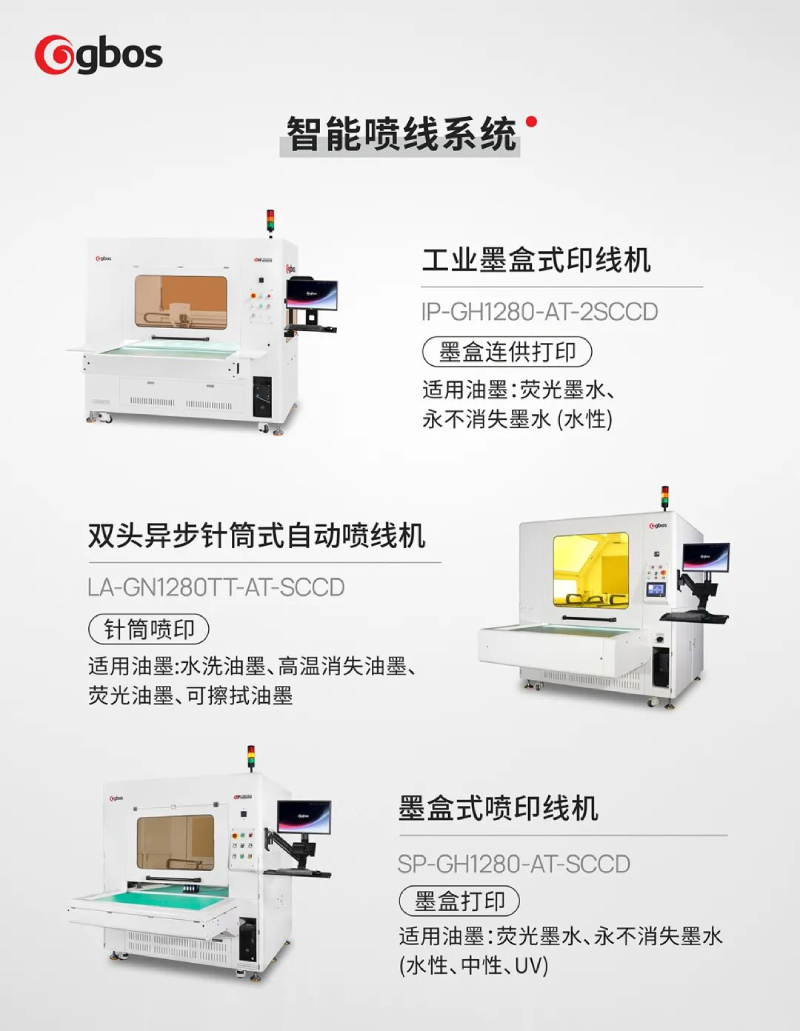
All three models integrate the SCCD AI VisionScan system, which automatically identifies cut parts and performs real-time positioning correction. This ensures consistent, sharp marking lines while eliminating common manual issues such as uneven line thickness, inaccurate positioning, and blurred markings.
Manufacturers can deploy a single model tailored to their primary products or combine all three into a comprehensive intelligent marking line capable of supporting everything from mass production to specialized manufacturing.
02. Fully Automated Material Feeding: Unlocking Unmanned Marking Production
Each marking machine can be equipped with the same fully automated material feeding unit, transforming marking from a labor-intensive process into an intelligent, unattended operation.
In conventional semi-automatic production, operators spend much of their time repeatedly loading, positioning, and securing cut parts. These repetitive tasks add little value while consuming significant labor resources.
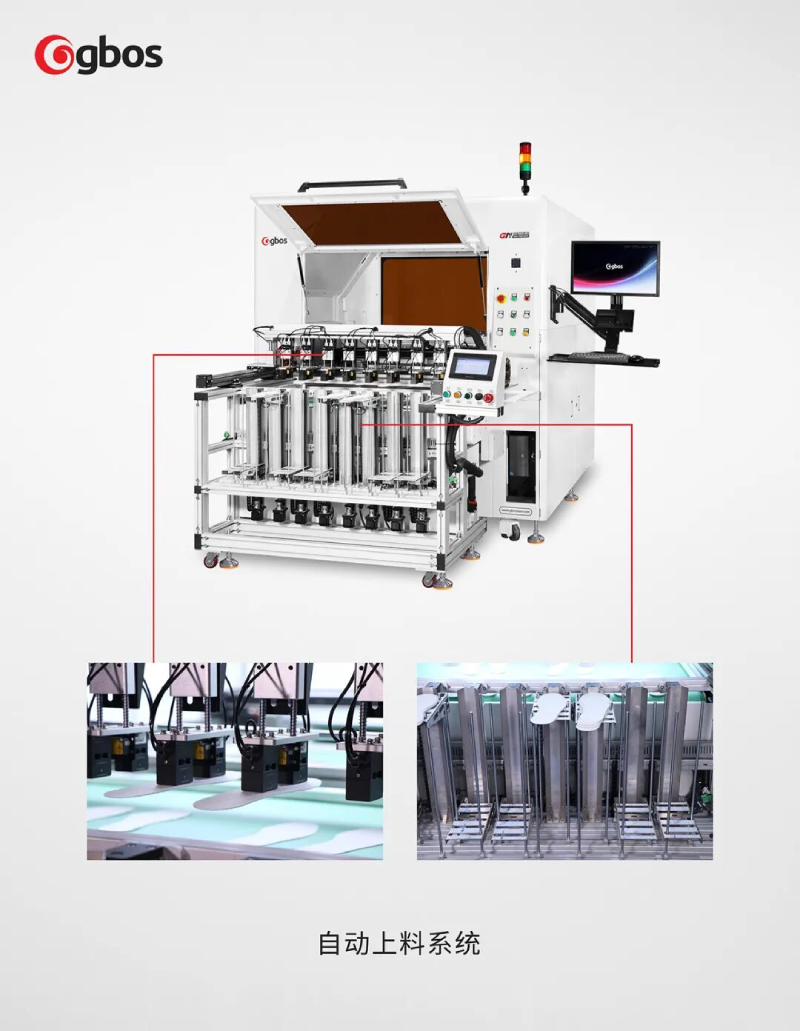
With the automated feeding unit, the workflow becomes dramatically simpler.
Operators only need to place stacks of cut parts onto the feeding rack. The system automatically performs material separation, vacuum pickup, conveying, precise positioning, and inkjet marking without manual intervention throughout the entire process.
Whether processing lightweight mesh, soft leather, or rigid PU components, the feeding system transports materials smoothly without shifting or wrinkling. Combined with AI vision positioning, it maintains consistently high marking accuracy throughout production.
The result is a significant reduction in labor requirements, the elimination of positioning errors caused by manual handling, and a higher overall production yield.
Designed with a modular architecture, the feeding unit can also be added to existing GBOS marking machines as production capacity expands. Manufacturers can upgrade their production lines without replacing entire machines, reducing capital investment while maintaining maximum flexibility.
03. Intelligent Automation Is the Foundation of Long-Term Competitiveness
Competition in today’s footwear industry extends far beyond product design or pricing. Success increasingly depends on cost efficiency, production flexibility, and the ability to respond quickly to changing market demands.
Although marking is often viewed as a supporting process, its hidden costs accumulate over time. Labor expenses, material waste, production downtime, and quality-related rework can significantly impact factory profitability.
Traditional manual operations and standalone equipment are no longer sufficient for an industry driven by small batches, rapid delivery, and multi-material production.
Intelligent automation has evolved from a productivity enhancement into a strategic necessity.

By allowing automated systems to handle repetitive tasks such as material feeding, positioning, and marking, manufacturers can reallocate skilled employees to higher-value activities like quality control, process optimization, and customer development.
The result is a more stable, efficient, and cost-effective production line—one that enables manufacturers to strengthen their competitiveness today while building the operational resilience needed for tomorrow’s footwear industry.
 Address: No. 1 Liansheng Road, Hongmei Town, Dongguan City, Guangdong Province. CN
  Tel: +86 769 88990609
  Fax: +86 769 88990677
  Email: