


Challenge|Who is the final winner in the footwear industry in 2022?

February 08, 2023
Return To List

Current market situation of footwear industry

Since the outbreak of Newcastle Pneumonia, the global economy has been hit hard, and the footwear industry is also facing a huge test. Although the footwear industry in China continues to grow, reports show that global footwear consumption will decrease by an average of 22.5% in 2021, with Europe down 27%, North America down 21% and Asia down 20%. The market operating environment of the footwear industry is extremely severe, and practitioners are facing tremendous pressure and challenges.

Equipment optimization, poised for growth

In the face of unstable market growth, companies face many challenges:
On the one hand, the industry is aiming for internationalization and market globalization, and on the other hand, the traditional footwear industry is facing problems such as high labor costs and uneven quality of production. In addition, the ever-changing market demand requires companies to produce and deliver orders faster and more efficiently, putting higher demands on the shoe supply chain system.

Companies must re-examine themselves to adapt to the changing demand conditions.

For example, replacing manual labor or outdated machines with advanced equipment, thus increasing productivity and significantly improving productivity.

A way to transform your production floor into a profit center

GBOS’ XXP3-180 high-speed laser marking machine brings a new solution to the footwear , enabling hollowing, marking and perforation of various shoe materials in the footwear field, empowering companies with new equipment.

For every 1% increase in production efficiency, 1% time savings can be achieved. Maximize production efficiency and create greater value.
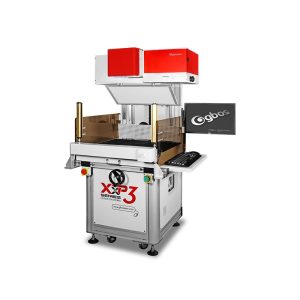
Faster speed and higher efficiency: 300 holes per second (0.2mm) is 15-20 times of ordinary marking machine, significantly improving production efficiency and meeting customer delivery requirements.

High quality marking: original optical system, fine marking effect. Significantly improve the reliability of mechanical operation, marking quality and performance.

Multifunctional all-in-one machine: punching, hollowing, marking and cutting processes are completed at once, solving the difficult problem of processing steps and helping enterprises to realize more possibilities.

Directly hit the processing pain points: processing materials do not produce yellow edges, scorched edges, production workshop without odor.

In addition to footwear manufacturing, the XXP3-180 can be applied to many industries such as garment, advertising, and automotive trim. In the future, GBOS will continue to adhere to the purpose of focusing on the needs of the industry, using innovative technology to provide customers with high-quality laser marking products and solutions to provide upgrade support for the industry.

Recommended news
  • White and light-colored apparel remains a timeless choice in the fashion industry, valued for its clean look and versatility across work and casual settings, reflecting today’s preference for simple, quality living. Behind this “pure aesthetic,” however, lies a long-standing cutting challenge for manufacturers: preserving the fabric’s original beauty while ensuring production efficiency and precision. 01 White Fabric Cutting: A Seemingly Simple but Highly Demanding Challenge In the business world, real pain points are often hidden within needs that appear simple at first glance. Consumers expect white apparel to be clean and flawless, breathable and comfortable, and durable down to the finest details—but meeting all three expectations at once is a real challenge for manufacturers. Natural cotton, linen, and eco-friendly specialty fabrics offer excellent breathability and comfort, yet they are extremely difficult to cut. Traditional laser cutting generates high heat that can cause yellowing, darkening, or scorching along the edges—an almost “fatal flaw” for white fabrics. The result is either scrapped material or compromised brand reputation, driving up waste and production costs. At the same time, modern garment features such as seamless pockets and waterproof bonding tapes require highly precise cutting to ensure quality. Inaccurate cuts from traditional methods often lead...
    Pub Date: Jan 28, 2026
  • The true refinement of automotive interiors is often hidden in the details you don’t immediately see. From a single piece of plastic raw material to a contoured trim part that fits seamlessly into the cabin, the precision and efficiency of the cutting process directly define the upper limit of product quality—and ultimately shape a manufacturer’s core competitiveness. 01 The Dual Challenge of Cutting Complex Automotive Interior Components As you sit inside a vehicle and run your fingers along the smooth curves of the center console or the precisely cut openings on the door panels, you probably don’t stop to think about how these complex, contoured parts are produced with such consistency. For automotive component manufacturers, however, achieving this level of precision has long been a hidden pain point in production. Traditional stamping dies are bulky and costly to change over, making them ill-suited for customized or irregularly shaped interior parts. Manual trimming, on the other hand, relies heavily on operator experience, often resulting in inconsistent accuracy, excessive burrs, and additional finishing processes that consume time, labor, and may even compromise part precision. As a result, the machining of complex interior parts is often trapped in a dilemma between low efficiency...
    Pub Date: Jan 17, 2026
Book an virtual demonstration with us to learn more about digital cutting and process solutions.
Request A Web/On Site Demo
Get Manufacturing and Process Solutions
Conatct now
Customization
Customized products
Find which machiney suits you best
Please select below options, it will help you find what you are looking for more quickly.
Choose your application(s) from the list.
NEXT STEP
Applied in roll or sheet materials?
PRE STEP
NEXT STEP
What is the max length and width of your material?
Length
Width
PRE STEP
NEXT STEP
Here are standard models for you:
PRE STEP