


As summer temperatures soar, swimming is emerging as one of the hottest summer trends for cooling off and staying active. Market data shows a steady rise in sales of swim-related products, with swimwear in particular riding the wave of consumer demand.


Surging Swimwear Demand Amid the Summer Economy Boom
As an essential piece of swim gear, swimwear continues to experience growing market demand. Today’s consumers are no longer satisfied with basic functionality alone—they are increasingly seeking the perfect blend of fashion, comfort, and personalization. This evolving trend presents unprecedented challenges for swimwear manufacturers.
 Challenges and Bottlenecks Facing Swimwear Manufacturers


Despite the surging market demand, swimwear manufacturers find themselves caught in a difficult dilemma.
On one hand, traditional manufacturing processes struggle to handle elastic fabrics efficiently, often falling short in achieving precise cutting. This lack of accuracy leads to significant material waste. According to industry data, cutting errors in conventional production methods contribute to substantial fabric loss—undeniably driving up overall manufacturing costs.
On the other hand, as consumer demand for personalized swimwear continues to rise, manufacturers are forced to frequently adjust their production processes to accommodate various styles and patterns. This constant adaptation significantly reduces production efficiency and extends lead times, further weakening the company’s competitiveness in an increasingly fast-paced market.

To secure a foothold in the competitive swimwear market, manufacturers need a comprehensive breakthrough strategy.

Perfect-Fit Production Solutions
Amid the numerous challenges facing the swimwear manufacturing industry today, GBOS offers high-quality solutions tailored for manufacturers.
- Efficient and Precise Cutting of Elastic Fabrics
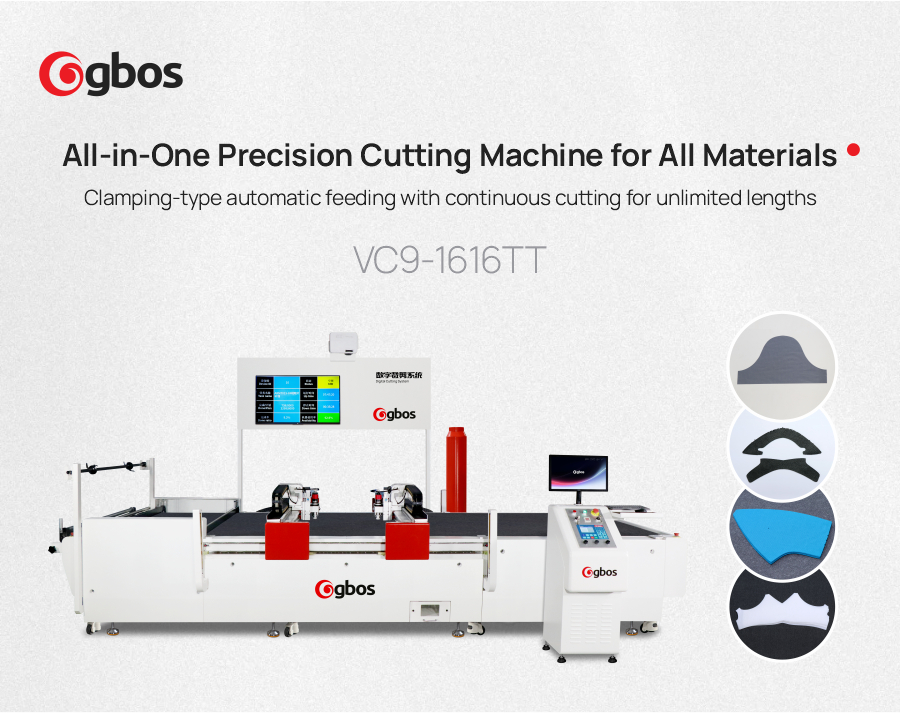
The VC9-1616TT premium thread cutting machine offers an excellent solution to the challenges of cutting elastic fabrics. Equipped with a dual-head asynchronous cutting system, it enables highly efficient coordinated operation, significantly boosting cutting efficiency and greatly accelerating the production pace.
The multi-layer automatic clamping and feeding system enables full automation of the production process. It not only reduces labor costs but also ensures precise control of the feeding operation, maintaining smooth material transport. This effectively minimizes production waste while optimizing both production efficiency and processing accuracy.
- Rapid Cutting with Large-Area Automatic Recognition
In high-volume production models, the fully automated feeding and cutting integrated machine GH1812TT-AT-SCCD can automatically recognize and locate large fabric areas, precisely capturing cutting contours with minimal manual intervention. This significantly reduces pre-processing time. Equipped with a dual-head interactive cutting system, it can simultaneously perform cutting tasks in different areas, markedly improving efficiency compared to traditional equipment.
Whether it’s intricate hollow patterns, digitally printed materials, or regular geometric shapes, the machine achieves precise cutting with smooth, burr-free edges—free from yellowing, blackening, or scorching. Combined with automatic feeding, it can continuously process roll fabrics and is compatible with elastic materials commonly used in swimwear production, such as Lycra and nylon, enabling full-process automation.

- High-Efficiency and Eco-Friendly Marking Machine
The UV3A Ultraviolet Laser Marking Machine demonstrates unique advantages in the seamless label marking application for swimwear production. It features high beam quality, low energy consumption, and environmentally friendly operation with cold air cooling, significantly reducing power usage and lowering operational costs while achieving maximum production efficiency. During the swimwear labeling process, it can create permanent marks directly on the fabric surface that do not fade and require no ink or other consumables.
The ultraviolet laser features a small focused spot, enabling ultra-fine marking. Even tiny patterns and text can be rendered with exceptional clarity. It achieves high-precision marking on any complex shapes, letters, numbers, and logos, meeting consumer demands for personalized customization.

From precise and rapid cutting of elastic fabrics to seamless label marking applications, GBOS equipment empowers manufacturers to boost production efficiency, reduce costs, and enhance product quality. It enables comprehensive automation, intelligence, and high efficiency throughout the production process, helping manufacturers stand out in a fiercely competitive market.

 Address: No. 1 Liansheng Road, Hongmei Town, Dongguan City, Guangdong Province. CN
  Tel: +86 769 88990609
  Fax: +86 769 88990677
  Email: