In 2023, BYD released a video titled “Together, We Are Chinese Cars,” which garnered widespread attention and enthusiastic response across the internet.
This video not only serves as a declaration of the BYD brand but also symbolizes the confidence and determination of China’s new energy vehicle industry. It marks the shift towards new energy vehicles becoming a major trend for the Chinese automotive industry to compete globally, continuously leading into the future.
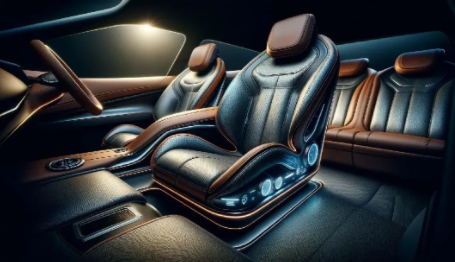
The global promotion and development of new energy vehicles not only demonstrate advancements in new energy technology but also underscore the importance of precision manufacturing of various car components for automakers. Among these components, the manufacturing process of car seats is particularly crucial.
When selecting seat suppliers, major automotive brands follow a set of evaluation criteria, preferring suppliers who can provide comprehensive solutions, demonstrate excellent environmental records, and possess innovative capabilities. These criteria include meeting standards in cutting processes, effectively saving leather materials to enhance cost-effectiveness, and other key indicators, all aimed at providing consumers with the ultimate comfort experience.
However, manufacturers are confronted with challenges brought about by the complexity of production due to changes in user demands and material types, especially in leather nesting and cutting processes. This process not only requires high levels of manual skill and time but is also prone to errors, often resulting in unnecessary production bottlenecks and capacity decline. Considering the high cost of leather materials themselves, maximizing savings in every inch of leather has become a major challenge.
■ GBOS Leather Nesting + Cutting Solution for Automotive Interiors
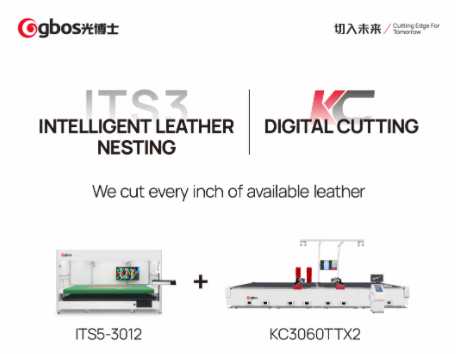
Addressing this challenge, GBOS has introduced a set of solutions for leather nesting and cutting in the automotive interior industry. This solution digitizes operations, reduces labor, minimizes material waste, simplifies cutting operations, and enhances product quality, laying a solid foundation for automotive manufacturers to improve production efficiency and profitability.
With proprietary algorithms, GBOS digital solution achieves the highest material utilization rate, reaching 85% or more, to achieve optimal nesting results in the most material-saving manner.
Compared to traditional manual methods, GBOS digital one-stop intelligent nesting + cutting solution [ITS5-3012 + KC3060TTX2] can:
■ Achieve over 85% material utilization rate;
■ Further increase material utilization through integrated nesting by 1.5%;
■ Support continuous nesting of multiple leather sheets without interruption;
■ Digitize operations, reduce the need for skilled leather craftsmen, and enable 24-hour uninterrupted operation.
Let’s work together! Together, let’s empower China’s intelligent manufacturing! Together, let’s make Chinese car interiors more beautiful and comfortable, with even higher quality! Together, let’s help Chinese cars run faster and farther!
As automotive interior design continues to evolve, dual-arc 3D curved surfaces have become a mainstream styling feature for headliners, typically combining suede-like soft upholstery with curved composite substrates. With rapid model iteration and increasing demand for customized orders, automakers require increasingly high levels of precision, acoustic transparency, and production efficiency for microphone hole cutting and irregular contour trimming on headliners. However, conventional universal processing equipment often lacks the adaptability required for these applications. Outdated processing methods make it difficult to meet the stringent requirements of 3D interior manufacturing, creating a critical bottleneck for quality improvement and productivity enhancement among many automotive interior suppliers. 1. Key Challenges in 3D Headliner Cutting The large 3D curvature and soft, multi-layer composite structure of automotive headliners present significant challenges for conventional cutting methods. Standard flat-bed cutting systems have clear limitations, as they cannot perform conformal cutting along complex curved surfaces. Traditional processing methods also rely heavily on dedicated tooling. High mold development costs and long lead times limit production flexibility, while even minor product changes or new-model launches may require new molds. In addition, repeated fixturing and repositioning can easily lead to misaligned microphone holes and dimensional deviations. These issues can affect headliner assembly...
The lingerie industry is undergoing a major transformation. The market for sports bras and seamless bras continues to grow, while orders are becoming more fragmented and delivery cycles are getting shorter. Small-batch, multi-style production is gradually becoming the norm. At the same time, consumers are demanding greater comfort, better shaping performance, and more functional designs. This is pushing manufacturers to work with increasingly diverse and complex fabric combinations. For lingerie factories, production therefore needs to become more flexible than ever—while cost control, cutting accuracy, and quality consistency must remain stable. 01 Two Common Fabrics, One Critical Cutting Challenge Lycra® and cotton are among the most widely used materials in lingerie manufacturing, but both can present significant challenges during cutting. Lycra® is highly elastic. When multiple layers are stacked, the fabric can stretch and shift between layers. Even small dimensional deviations in the cut pieces can affect subsequent sewing and, in severe cases, result in an entire batch being rejected. Cotton presents a different challenge. Its soft texture can make cutting more difficult when the blade is not sharp or stable enough. Frayed edges, material adhesion, and inconsistent cutting results may then lead to additional manual rework. These challenges become even...
Pub Date: Sep 10, 2026
Book a virtual demo to explore our digital cutting and process solutions.




 Address: No. 1 Liansheng Road, Hongmei Town, Dongguan City, Guangdong Province. CN
  Tel: +86 769 88990609
  Fax: +86 769 88990677
  Email: gbos@gboslaser.com