


3D 5-axis laser cutting machine, for now and for the future!

February 08, 2023
Return To List

2015, Launch three-axis laser cutting machine.

2017, Launch four-axis laser cutting machine.

2019, Launch five-axis laser cutting machine. (and delivery the first 3D five-axis laser cutting machine in the same year)

The breakthrough of GBOS’s 3D five-axis technology not only represents a better process application for users, but also brings undeniable power to promote the development of the industry.
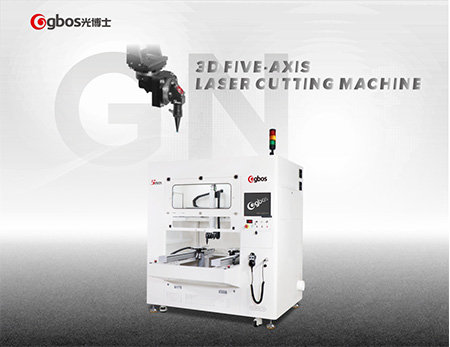
3D laser cutting machine

As an innovative product applied to the non-metallic field, it has shown many excellent advantages and highlights in helping various industries to transform and upgrade. In the process of processing, no moulds are required, thus reducing the cost of mould opening and mould management; secondly, the application of trimming and cutting holes for various shaped and 3D curved products greatly improves production efficiency.

As the level of intelligent continues to rise, the 3D complex surface laser cutting process has also continued to make breakthroughs and is now successfully used in small/large batch manufacturing in industries such as automotive, aerospace, lighting, luggage and lingerie.

It enables the trimming and punching of shaped edges and holes for automotive interior injection moulded parts, car lamp spouts and luggage blister parts, greatly increasing the efficiency of the production process and producing products with smooth and burr-free cuts that can be used directly without the need for subsequent treatment of the cuts.
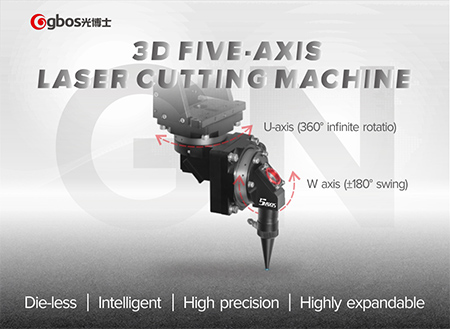
3D laser cutting machine

Not only that, for applications in various industries, the products follow several design concepts such as die-less & intelligent, high precision, high expandability, personalisation, 360° infinite rotation and safety, providing users with efficient and high value 3D 5-axis laser cutting machines.

  • Die-less and intelligent: die-less cutting solves the problem of many dies in the traditional stamping method and promotes the development of enterprises in the direction of intelligence.
  • High precision: enclosed double module guide and screw drive, faster cutting speed and higher cutting accuracy to meet the increasing demands of product quality.
  • Infinite Rotation: The U-axis 360° infinite rotation and the W-axis ±180° arbitrary oscillation of the non-metallic mould-free 3D five-axis laser cutting machine have been developed by precise optical calculations.
  • Highly scalable: any combination of dual workstations (double Y), single workstations (single Y) or dual Y in and out workstations according to requirements.
  • Personalisation: no longer constrained by traditional processing methods, promoting individual product design.
  • Safety: contactless closed design, safety grating protection and off-line working design in accordance with CE international safety standards.
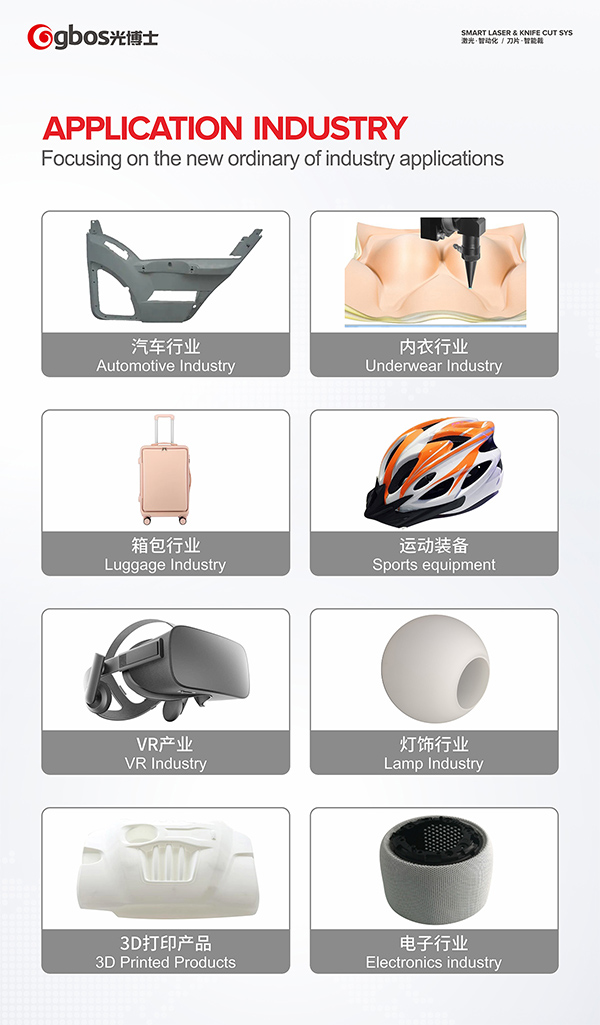
3D five axis laser cutting machine


3D 5-axis laser cutting technology, the present and the future.

Recommended news
  • White and light-colored apparel remains a timeless choice in the fashion industry, valued for its clean look and versatility across work and casual settings, reflecting today’s preference for simple, quality living. Behind this “pure aesthetic,” however, lies a long-standing cutting challenge for manufacturers: preserving the fabric’s original beauty while ensuring production efficiency and precision. 01 White Fabric Cutting: A Seemingly Simple but Highly Demanding Challenge In the business world, real pain points are often hidden within needs that appear simple at first glance. Consumers expect white apparel to be clean and flawless, breathable and comfortable, and durable down to the finest details—but meeting all three expectations at once is a real challenge for manufacturers. Natural cotton, linen, and eco-friendly specialty fabrics offer excellent breathability and comfort, yet they are extremely difficult to cut. Traditional laser cutting generates high heat that can cause yellowing, darkening, or scorching along the edges—an almost “fatal flaw” for white fabrics. The result is either scrapped material or compromised brand reputation, driving up waste and production costs. At the same time, modern garment features such as seamless pockets and waterproof bonding tapes require highly precise cutting to ensure quality. Inaccurate cuts from traditional methods often lead...
    Pub Date: Jan 28, 2026
  • The true refinement of automotive interiors is often hidden in the details you don’t immediately see. From a single piece of plastic raw material to a contoured trim part that fits seamlessly into the cabin, the precision and efficiency of the cutting process directly define the upper limit of product quality—and ultimately shape a manufacturer’s core competitiveness. 01 The Dual Challenge of Cutting Complex Automotive Interior Components As you sit inside a vehicle and run your fingers along the smooth curves of the center console or the precisely cut openings on the door panels, you probably don’t stop to think about how these complex, contoured parts are produced with such consistency. For automotive component manufacturers, however, achieving this level of precision has long been a hidden pain point in production. Traditional stamping dies are bulky and costly to change over, making them ill-suited for customized or irregularly shaped interior parts. Manual trimming, on the other hand, relies heavily on operator experience, often resulting in inconsistent accuracy, excessive burrs, and additional finishing processes that consume time, labor, and may even compromise part precision. As a result, the machining of complex interior parts is often trapped in a dilemma between low efficiency...
    Pub Date: Jan 17, 2026
Book an virtual demonstration with us to learn more about digital cutting and process solutions.
Request A Web/On Site Demo
Get Manufacturing and Process Solutions
Conatct now
Customization
Customized products
Find which machiney suits you best
Please select below options, it will help you find what you are looking for more quickly.
Choose your application(s) from the list.
NEXT STEP
Applied in roll or sheet materials?
PRE STEP
NEXT STEP
What is the max length and width of your material?
Length
Width
PRE STEP
NEXT STEP
Here are standard models for you:
PRE STEP