



The leather industry is undergoing a profound transformation.
As downstream brands demand increasingly stringent quality standards, raw material costs continue to rise, while skilled technicians are becoming harder to find. For many factories, simply adding more workers is no longer a sustainable way to increase production capacity or revenue.
The real opportunity lies in transforming experience-driven craftsmanship—traditionally dependent on the judgment of skilled technicians—into quantifiable, repeatable, and standardized digital processes.
Leather inspection is the first critical step in this transformation. As the gateway to genuine leather processing, inspection directly influences material utilization, production efficiency, and final product quality.
01 | Subjective Judgment: The Hidden Cost of Manual Inspection
Traditional leather inspection relies heavily on workers visually identifying defects and marking them with chalk. While experienced inspectors can make accurate judgments, human attention and consistency have inherent limitations.
Prolonged visual inspection can lead to fatigue, increasing the risk of missed defects or inaccurate judgments. Different inspectors or shifts may also evaluate the same hide differently, resulting in inconsistent grading and defect marking.

The consequences extend far beyond the inspection process.
When defects are missed, they may remain hidden until later stages of production, when correcting them becomes more difficult and costly. Materials and labor may already have been invested in processing a defective area, potentially turning a small inspection error into significant production waste.
More importantly, the expertise of highly experienced inspectors is difficult to replicate at scale. Without objective and standardized inspection criteria, factories may struggle to maintain consistent quality across teams, production lines, and different manufacturing sites.
The result is a familiar dilemma: production capacity remains constrained, material waste stays high, and profit margins become increasingly difficult to protect.
02 | Objective Standards: Turning Inspection into Digital Data

The “AI Intelligent Leather Inspection System AI-ITS1620” is designed to address these challenges by transforming leather inspection from a manual, experience-dependent task into a standardized digital process.
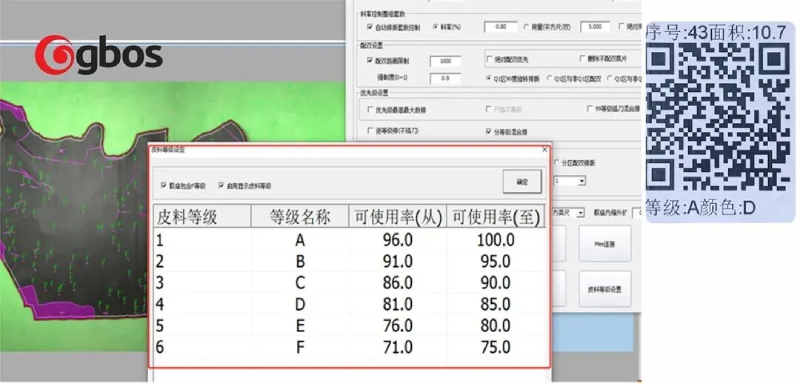
Aligned with internationally recognized SATRA quality inspection and grading standards, the system translates industry expertise into AI-powered inspection algorithms, helping reduce the subjectivity inherent in manual inspection.
In just “7–10 seconds”, each hide can be scanned, inspected for defects, measured, and automatically graded. The system also generates a unique electronic ID for each hide, creating a digital record that can be tracked throughout the production process.
More importantly, inspection no longer needs to function as an isolated operation.
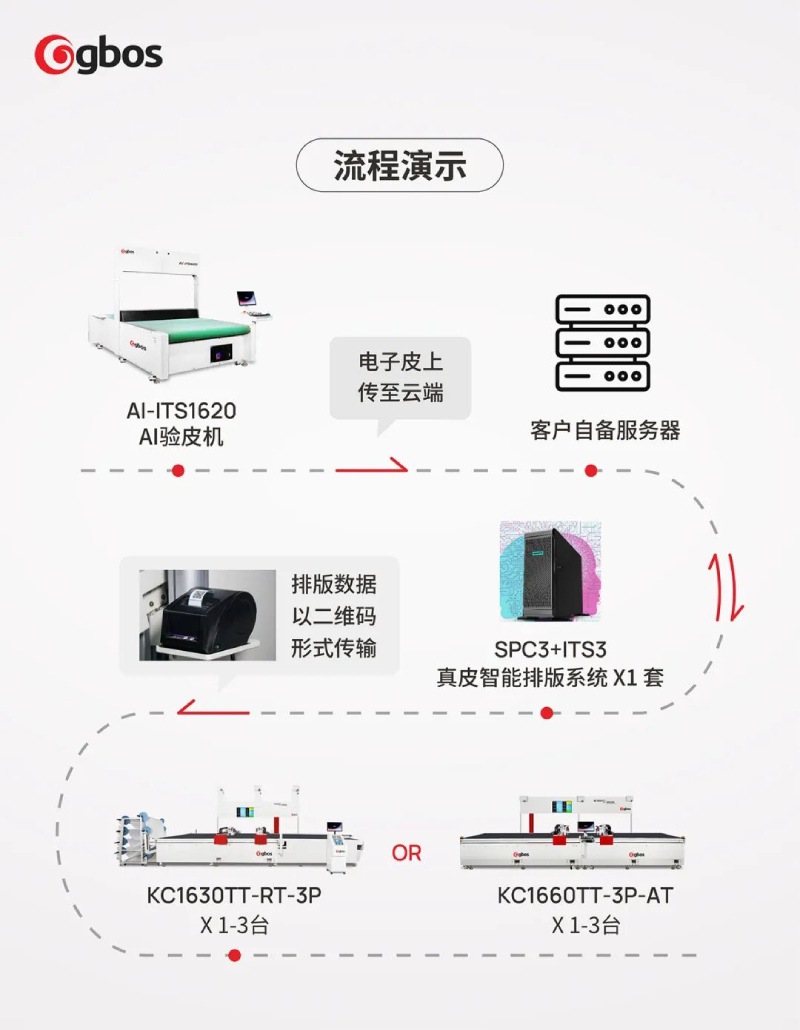
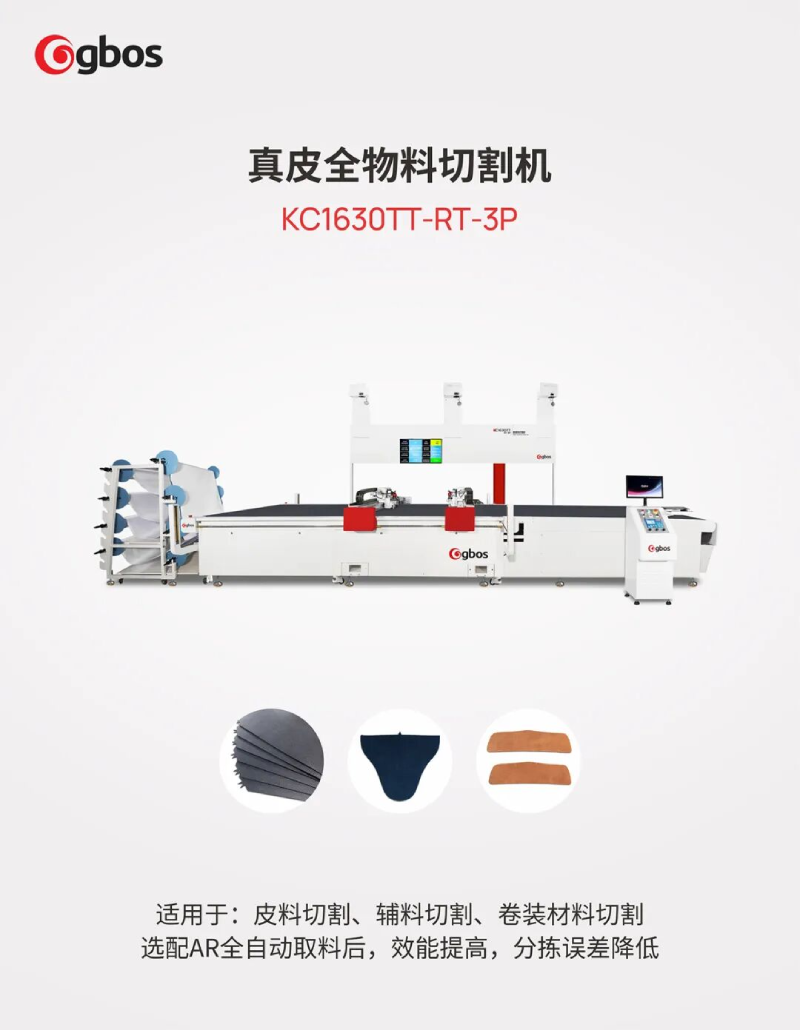
The AI-ITS1620 can connect inspection data with GBOS’s “Intelligent Leather Nesting System”, allowing inspection results to directly inform nesting and layout planning. The optimized nesting data can then be transferred to GBOS’s “oscillating knife cutting system” for precision cutting.
This creates a connected“Inspection → Nesting → Cutting”workflow.
No manual chalk marking. No repeated data entry. No disconnected production stages.
Instead, inspection data becomes a usable production asset—flowing directly from the identification of leather defects to material utilization and precision cutting.
This integration helps factories make better use of every hide while reducing unnecessary material loss. At the same time, it makes production less dependent on the availability of highly experienced technicians and creates a more consistent foundation for scalable manufacturing.
03 | Industrial Upgrade: From Uncertainty to Predictability
In leather manufacturing, the competitive advantage is not simply having access to better hides. It is about “extracting the maximum possible value from every hide”.
When inspection, grading, nesting, and cutting are connected through digital systems, factories can reduce their dependence on individual experience and minimize the impact of human fatigue, inconsistent judgment, and workforce turnover.
In an environment where leather prices remain high and market competition continues to intensify, three priorities are becoming increasingly important:
• Reduce material waste.
• Increase production efficiency.
• Build consistent, standardized quality.
These are not merely operational improvements. Together, they form a stronger foundation for long-term manufacturing competitiveness.

Looking ahead, GBOS will continue to advance intelligent leather manufacturing by connecting digital inspection, intelligent nesting, and automated cutting into more integrated production workflows.
By working closely with partners across the leather value chain, GBOS aims to help build a more efficient, standardized, and sustainable ecosystem for global leather manufacturing—and provide manufacturers with the digital foundation they need to move from “experience-driven production to data-driven growth”.
 Address: No. 1 Liansheng Road, Hongmei Town, Dongguan City, Guangdong Province. CN
  Tel: +86 769 88990609
  Fax: +86 769 88990677
  Email: