



Woven mark , like a delicate finishing touch on clothing, is not only a sign of excellent quality and ultimate comfort, but also a carrier of the brand’s unique charm and extraordinary recognition. It is like a bright artistic treasure in clothing design, leading the trend of the wind vane, giving the wearer an endless sense of fashion and personality style.
In the pursuit of design diversification, refinement and personalization of the wave, the cutting and processing of woven labels are facing unprecedented challenges. In particular, multi-graphics, multi-style woven labels accurate cutting, has become a major problem for many users of the accessories label industry.
PART 01
The beauty and challenge of the art of woven label
Just think, an exquisite jacket, its chest or sleeve arm parts of the woven mark label, the color needs to be a perfect blend with the clothing, patterns and text need to be fine and subtle, in order to highlight the unique charm of the brand and high-end texture.
However, unfortunately, the traditional woven mark label processing methods, most of which still remain in the manual or simple mechanical cutting stage, these means not only cutting style dull, difficult to accurately and delicately deal with shaped or irregularly shaped label.
More seriously, this type of simple processing methods there are limitations that can not be ignored, can only barely cope with the most common rules of woven mark label cutting, lack of necessary flexibility and adaptability, difficult to quickly and accurately respond to different brands for diversified, personalized manufacturing needs.
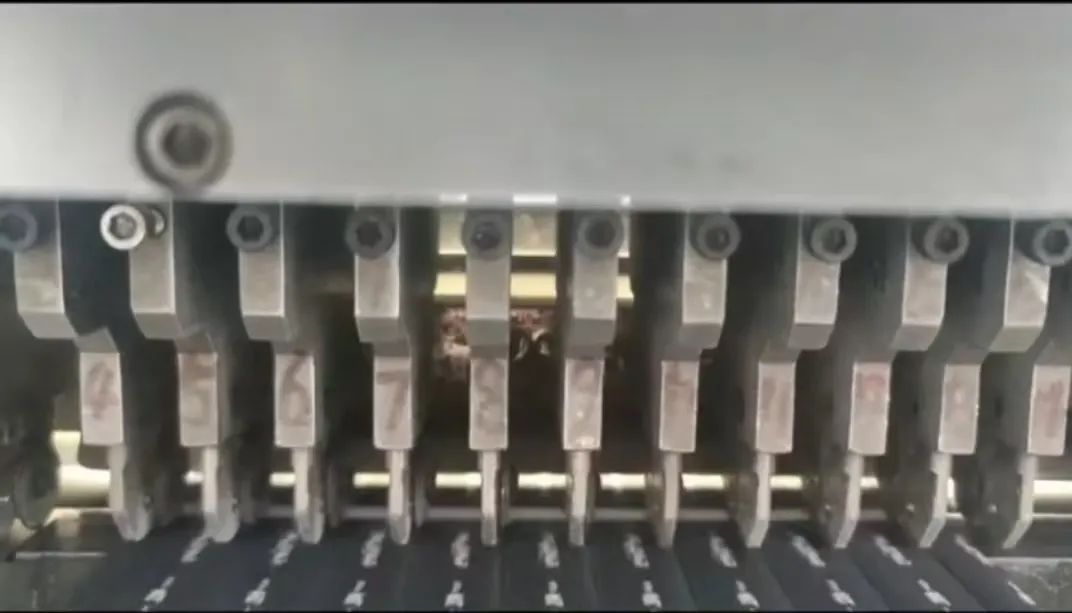
(Simple cutting machine, can only cut standard shaped woven labels, poor flexibility)
PART 02
Breakthrough Dual-Station High-Efficiency Logo Cutting And Slicing Machine.
It is in this context, FB06CCD Dual-Station High-Efficiency label Cutting And Slicing Machine came into being, which redefines the cutting process of woven mark label in the name of innovation, and brings revolutionary changes in the field of garment accessories cutting.
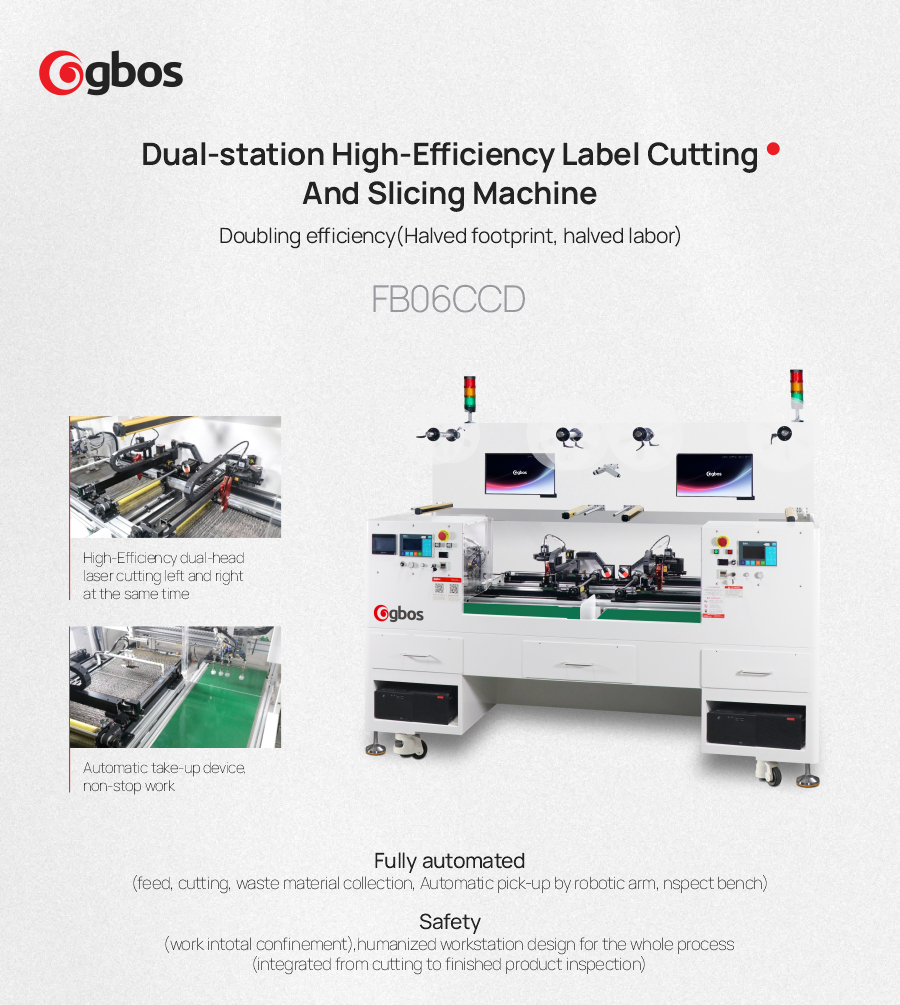
AI Intelligent Visionscan 5.0: The machine is equipped with two advanced AI intelligent visionscan systems, capable of accurately recognizing woven mark label of various shapes, colors and even complex patterns, and easily achieving precise positioning and cutting along the edge.
Dual-station independent operation: another highlight is its dual work area design, two areas can be operated independently. This design not only dramatically improves cutting efficiency, but also significantly enhances processing flexibility, fully meeting the urgent needs of the modern garment industry for diversified and personalized products.
Dual laser cutting system: The dual laser cutting heads equipped on the left and right sides of the machine realize true parallel operation, completely breaking the efficiency bottleneck under the single laser cutting system.
Automated pickup and inspection: the equipped robotic arm automatically picks up the material after cutting and accurately conveys the finished product to the inspection table, which greatly reduces the burden of manual operation and improves the efficiency and accuracy of QC inspection.
Dual feeding, dual waste collection design: further simplifies the operation process, reduces downtime, and once again improves overall work efficiency. This design not only improves the continuity of processing, but also effectively reduces the cost of waste disposal, contributing to the cause of environmental protection.
PART 03
Join hands to build a new chapter in garment accessories cutting
in Here, we sincerely invite every partner committed to the development of the apparel industry, hand in hand, and jointly explore the new height of the weaving mark label cutting technology. Let us work together, with the power of science and technology to reshape the cutting process of woven labels, and jointly write a new chapter in the field of cutting clothing accessories, create a better future!
 Address: No. 1 Liansheng Road, Hongmei Town, Dongguan City, Guangdong Province. CN
  Tel: +86 769 88990609
  Fax: +86 769 88990677
  Email: