


As intelligent manufacturing continues to evolve, common production challenges are becoming increasingly visible. Standardized equipment often lacks flexibility. Irregular or curved components are difficult to process. Production capacity struggles to keep pace with order growth. Conventional machines cannot meet specialized process requirements.

When enterprises attempt to upgrade production lines, finding truly suitable equipment becomes a major obstacle—ultimately limiting improvements in both quality and efficiency.
Against this backdrop, customized intelligent solutions are no longer optional—they are essential.
01 Precision-Driven Customization for Real Production Needs
A leading automotive interior manufacturer, supplying headliner assemblies to major OEMs, faced a critical challenge: precision cutting of microphone apertures in automotive headliners.
The application was technically demanding:
● Suede-like soft upholstery laminated to a double-arc curved composite substrate.
● Mold-free processing requirement.
● Micron-level accuracy.
● Zero positional deviation.
● Optimal acoustic transparency.
● High production throughput.
Conventional equipment could not achieve conformal cutting across large curved surfaces. Traditional processing methods resulted in high costs and low yield rates. What the customer needed was not another generic cutter—but a fully integrated, purpose-built solution.
After thoroughly evaluating on-site production conditions, part dimensions, and quality standards, GBOS developed the “GN3115 3D Five-Axis Laser Cutter”, a system specifically engineered for this application.
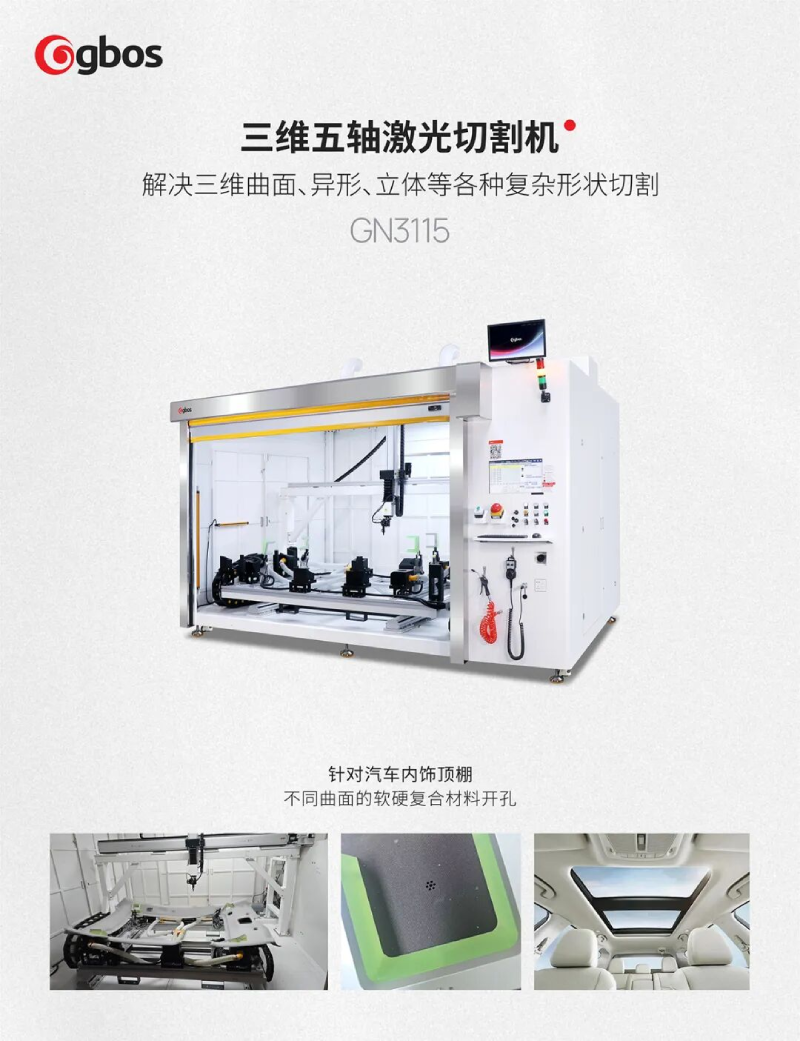
With its optimized mechanical architecture and motion control design, the GN3115 offers:
● Compact footprint.
● Seamless integration into existing production lines.
● Simplified commissioning.
● Fast ramp-up to stable production.
Most importantly, it delivers high-precision, high-volume cutting performance for complex curved geometries—effectively resolving the customer’s core production bottleneck.
02 The Core Advantage of 3D Five-Axis Technology
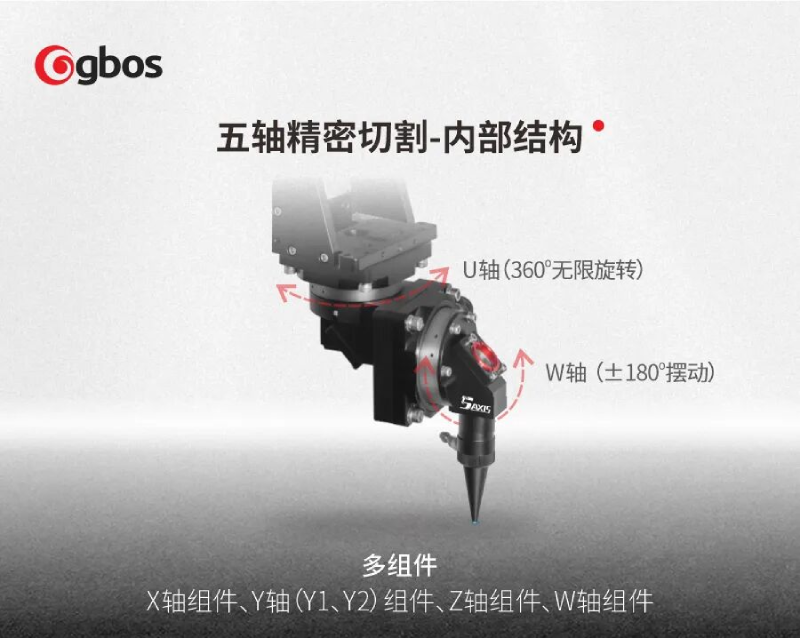
Built on GBOS’s mature 3D five-axis platform, this solution goes beyond traditional 2D processing limitations. It enables precise machining of:
● Complex curved surfaces.
● Irregular contours.
● Multi-angle and multi-directional features.
Key advantages include:
● Large working envelope.
● Consistent form accuracy.
● High adaptability across diverse part families.
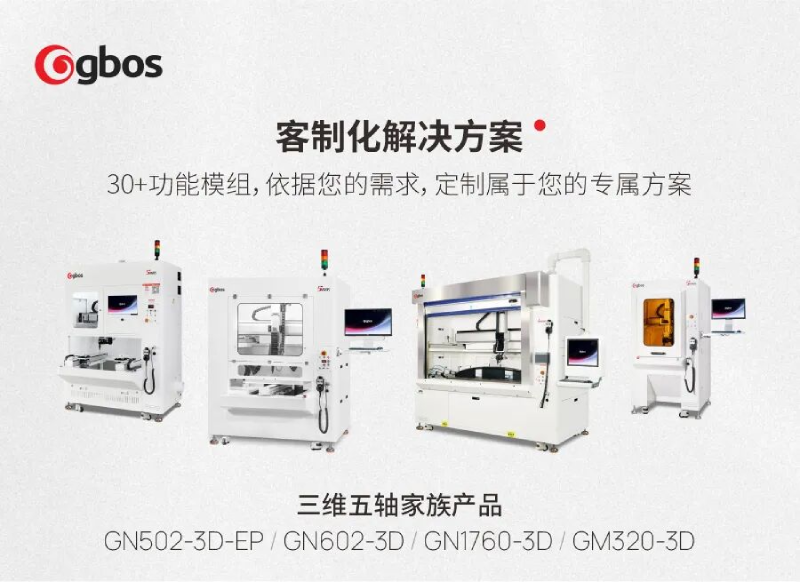
Beyond the GN3115, GBOS provides full-spectrum customization—adjusting functional modules, motion configurations, and processing modes based on industry characteristics and production scale.
Whether for small-batch precision applications or large-scale mass production, the system can be tailored accordingly.
The result:
● High operational stability.
● Ultra-low failure rate.
● Consistent output quality.
● Measurable productivity improvement.
This flexibility allows manufacturers to respond quickly to fluctuating market demand while maintaining strict quality standards.
03 Customization: The Future of Intelligent Manufacturing
As competition intensifies, standardized equipment alone can no longer support sustainable growth. Customized intelligent processing systems are becoming the dominant path toward industrial upgrading.

Looking ahead, GBOS will continue strengthening its R&D capabilities and customization services—enhancing both product performance and on-site implementation support.
Through highly adaptive, efficient, and reliable tailored solutions, GBOS remains committed to helping partners:
● Break through production constraints.
● Expand capacity steadily.
● Enhance long-term competitiveness.
● Capture emerging opportunities in industry transformation.
In today’s manufacturing landscape, customization is not simply an upgrade—it is the foundation of future-ready production.
 Address: No. 1 Liansheng Road, Hongmei Town, Dongguan City, Guangdong Province. CN
  Tel: +86 769 88990609
  Fax: +86 769 88990677
  Email: