


White and light-colored apparel remains a timeless choice in the fashion industry, valued for its clean look and versatility across work and casual settings, reflecting today’s preference for simple, quality living.
Behind this “pure aesthetic,” however, lies a long-standing cutting challenge for manufacturers: preserving the fabric’s original beauty while ensuring production efficiency and precision.
01 White Fabric Cutting: A Seemingly Simple but Highly Demanding Challenge
In the business world, real pain points are often hidden within needs that appear simple at first glance.
Consumers expect white apparel to be clean and flawless, breathable and comfortable, and durable down to the finest details—but meeting all three expectations at once is a real challenge for manufacturers.

Natural cotton, linen, and eco-friendly specialty fabrics offer excellent breathability and comfort, yet they are extremely difficult to cut. Traditional laser cutting generates high heat that can cause yellowing, darkening, or scorching along the edges—an almost “fatal flaw” for white fabrics. The result is either scrapped material or compromised brand reputation, driving up waste and production costs.
At the same time, modern garment features such as seamless pockets and waterproof bonding tapes require highly precise cutting to ensure quality. Inaccurate cuts from traditional methods often lead to adhesive failure during heat sealing. Combined with single-machine operation and complex workflows, conventional equipment leaves factories stuck in a dilemma: work slowly and struggle to deliver fine results, or speed up and risk defects.
Preserving aesthetics while maintaining efficiency and precision has become a core dilemma for the industry.
02 Breaking the Deadlock: Three Core Solutions of the GNM1480T
The launch of the GBOS GNM1480T dual honeycomb left–right interactive laser cutting machine breaks the stalemate through technological innovation, delivering an optimal solution for white fabric cutting.
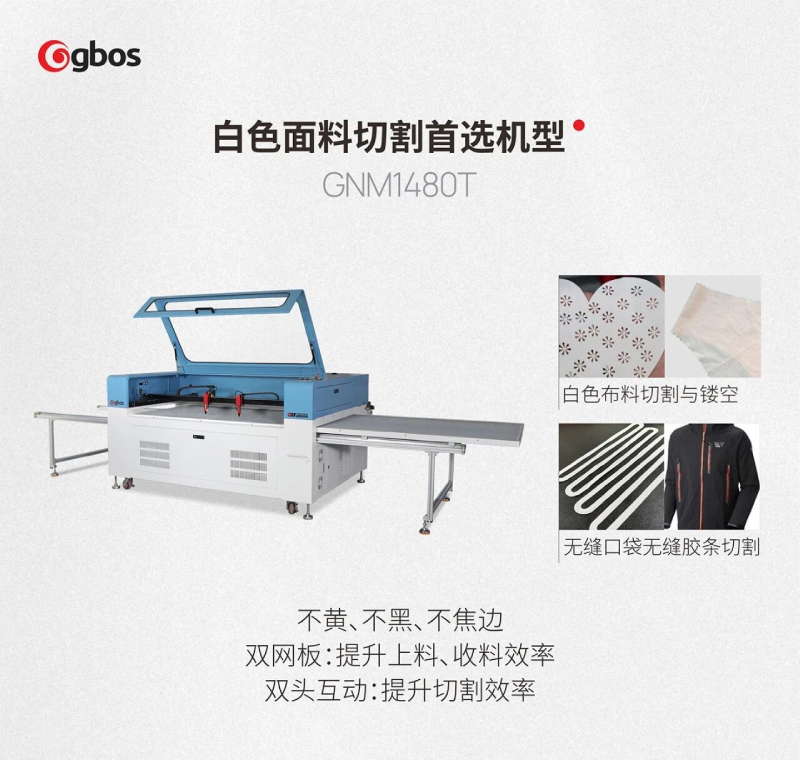
① Precise Color Protection: Preserving Purity at the Source
Designed specifically for white fabrics, the GNM1480T features an advanced laser system that precisely controls heat and cutting paths, effectively eliminating yellowing, scorch marks, and dark edges—while fully preserving the fabric’s original texture and color.
With no need for post-cut trimming, it reduces processing steps and costs while minimizing material waste—ensuring the beauty of white fabrics remains uncompromised.
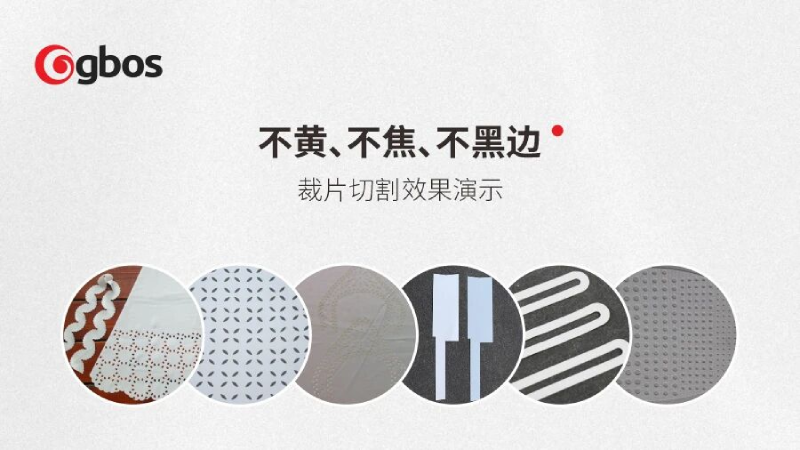
② Dual-System Synergy: Redefining Efficiency
The key to efficiency gains lies in workflow reengineering. Featuring a dual honeycomb left–right interactive design, the system enables cutting on one side while loading and unloading on the other—eliminating downtime between material changes. Paired with a dual-laser setup, synchronized operation effectively doubles productivity, significantly shortening lead times and keeping production agile during peak seasons.
③ Intelligent Simplification: Reducing Uncertainty and Waste
Production losses often stem from human error. The GNM1480T’s DSP digital control system transforms complex parameters into an intuitive interface, allowing even new operators to get started quickly while reducing training costs and operational mistakes. At the same time, the machine delivers precise cutting for seamless materials and intricate hollow patterns, with a very low risk of adhesive failure after heat bonding—expanding application possibilities and enabling creative designs to be realized with confidence.
03 End-to-End Value Upgrade: Confidence for Manufacturers, Comfort for Consumers
For manufacturers, the GNM1480T addresses three critical pain points—high material waste, low efficiency, and inconsistent precision—turning operational improvements directly into competitive advantage. For consumers, these technological upgrades at the production level translate into a flawless wearing experience: white garments with clean, burn-free edges and secure seamless details that balance aesthetics with everyday practicality.
Amid the wave of consumption upgrades, the industry is shifting from meeting basic needs to pursuing exceptional experiences.

GBOS breaks long-standing industry trade-offs through technological innovation, redefining the true value of smart manufacturing: delivering simple, precise, and efficient solutions to needs that only appear simple. Together, we unlock intelligent production solutions—so the pure beauty of white fabrics is no longer constrained by cutting limitations.
 Address: No. 1 Liansheng Road, Hongmei Town, Dongguan City, Guangdong Province. CN
  Tel: +86 769 88990609
  Fax: +86 769 88990677
  Email: