



The sports shoes market, a fertile land full of vigor and innovation, is interpreting the perfect fusion of functionality, fashion and comfort at an unprecedented speed. Each pair of shoes is not only a walking companion, but also a display of personality and taste.
01 The Dilemma of Traditional Craftsmanship: An In-Depth Analysis of Limitations
Going back in time, workers on the factory floor, armed with hammers and nails, performed punching tasks by hand with pure skill. This not only tests their patience and precision, but is also a fond look back at the traditional manufacturing model.
However, the shortcomings of manual punching should not be ignored: the size of the hole is difficult to standardize, and precision control has become a problem; the operational efficiency is low, and it is difficult to match the speed of the modern production line; coupled with the potential damage to the material by manual operation, each batch of products is like a gemstone that has not been meticulously carved and lacks uniform norms and aesthetic value, and it is difficult to satisfy the contemporary consumer’s expectations for the double quality and efficiency.
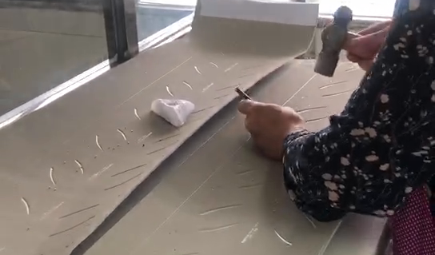
(Traditional manufacturing methods)
02 Innovation Process,Defining new standards
Against this background, GBOS XXP3.1-180-CCD high-speed laser marking and cutting machine came into being and quickly became the leader of GBOS digital laser product line. It has revolutionized the shoe industry, garment accessories industry, 3C electronics industry, and packaging and printing industry with its outstanding performance.
The marking cutting machine, with its high-speed and lightweight, accurate and efficient features, solves the problem of consistency of the traditional process and ensures that each batch of goods is punched with a uniform standard, so that the beauty of shoes, from the details of the bloom.
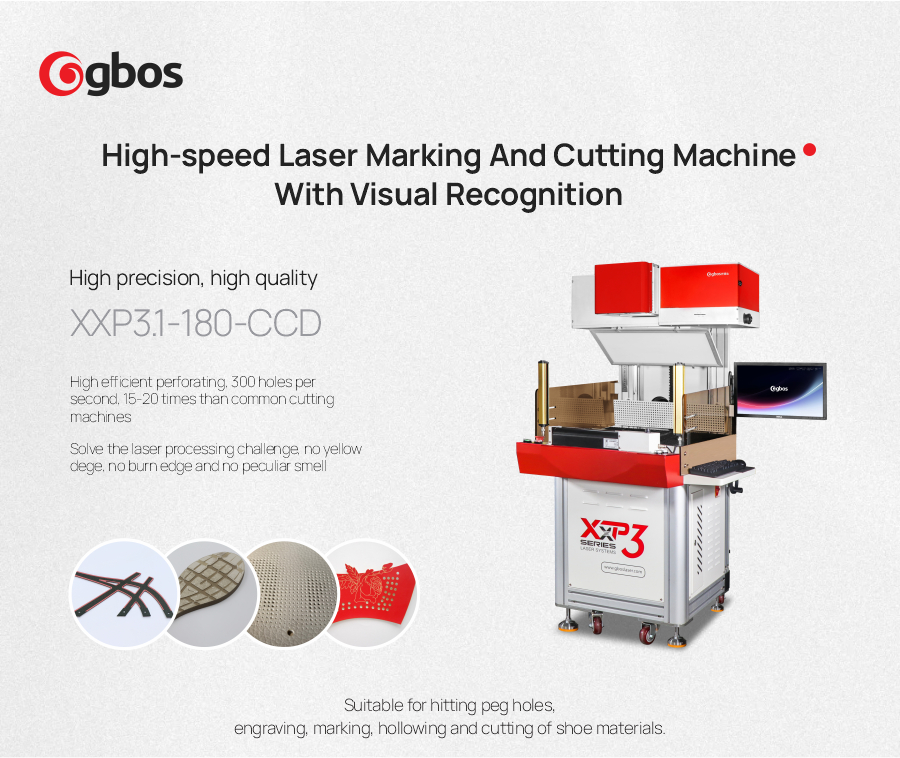
Top of the speed, efficiency doubled: In terms of speed, XXP3.1-180-CCD is even leading the industry with amazing performance. It can complete 300 holes per second, the efficiency is far more than the traditional laser machine 10-15 times (the specific efficiency depends on the size of the hole and the material).
Multi-application, unlimited creativity: What’s more remarkable is that the system is not only limited to punching holes, but its wide range of applications also revitalizes the shoe manufacturing industry. It is suitable for sole marking, with a minimum line width of 0.255mm, and can also mark, carve, punch ventilation holes, cut and engrave leather uppers.
AI visionscan, intelligent leading: equipped with high-precision AI visionscan recognition system, it can automatically extract material graphics and complete multi-process applications, making shoe manufacturing more intelligent and automated.
Modular design, flexible and versatile: In addition, the modular design enables it to be equipped with an optional automatic feeding system to realize the cutting and punching of rolled materials, which further enhances the flexibility and efficiency of the production line.

In the future, GBOS will continue to deepen the one-stop intelligent tailoring and creative process solutions, and lead the footwear industry to a high degree of automation and intelligence with smarter, more efficient, and more accurate innovative technologies, so that every pair of shoes will become the art of walking, and lead the trend with a brilliant step.
 Address: No. 1 Liansheng Road, Hongmei Town, Dongguan City, Guangdong Province. CN
  Tel: +86 769 88990609
  Fax: +86 769 88990677
  Email: