


A football jersey is defined by more than its fabric, fit, and color. The details matter—and among them, the logo is one of the clearest expressions of brand identity and product quality.
Today’s consumers pay close attention to the logos and labels placed on the chest, sleeves, and other parts of a jersey. Woven labels, printed ribbon labels, and multi-layered labels, often supplied in rolls, must deliver both visual precision and long-term durability. Their edges need to be clean and consistent, while the finished labels must withstand washing, stretching, and everyday wear.

As brands demand higher quality and order volumes continue to grow, contract manufacturers face a familiar challenge: how to increase production capacity without sacrificing yield or consistency.
Winning an order is only the beginning. The real challenge is delivering every piece to the required standard, on time.
01 | Where Traditional Logo Cutting Falls Short
Football jersey logos come in many forms, and each material presents its own processing challenges.
Woven labels require clean, burr-free edges. Printed ribbons must retain their graphics without surface damage. Multi-layered labels require stable cutting across different material thicknesses, while irregular logos and cut-out designs demand precise contour control.

For manufacturers still relying on traditional cutting equipment, several problems can quickly become production bottlenecks:
• Limited production capacity: Conventional equipment often has a clear throughput ceiling. Factories may need multiple machines and additional operators to handle large orders, increasing labor, floor-space, and management costs while extending lead times.
• Inconsistent cutting quality: Frayed edges, damaged print patterns, and inaccurate contours can result in rework and rejected pieces. Over time, material waste and reprocessing costs can significantly reduce margins.
• Limited processing flexibility: Complex cut-outs, engraving, and multi-layer cutting can be difficult to execute consistently with conventional equipment. As a result, manufacturers may have to simplify designs or compromise on what can be produced.
• Smoke and heat-related contamination: Cutting processes that generate smoke and fumes can cause yellowing, blackening, or secondary contamination, compromising the appearance of finished labels.
• Maintenance and downtime: Under continuous high-load operation, aging equipment can suffer from declining precision, unexpected breakdowns, and increasing maintenance requirements. Unplanned downtime further reduces actual production capacity.
This creates a difficult situation for manufacturers: brands expect greater precision and faster delivery, while traditional equipment introduces more labor, maintenance, rework, and production risk.
The result is a cycle that many factories know all too well: orders continue to grow, but delivering them efficiently becomes increasingly difficult.
02 | A Smarter Approach: High-Speed Roll-Fed Logo Cutting
These challenges call for more than simply adding another machine. Manufacturers need a cutting solution designed around the way modern logo production actually works.
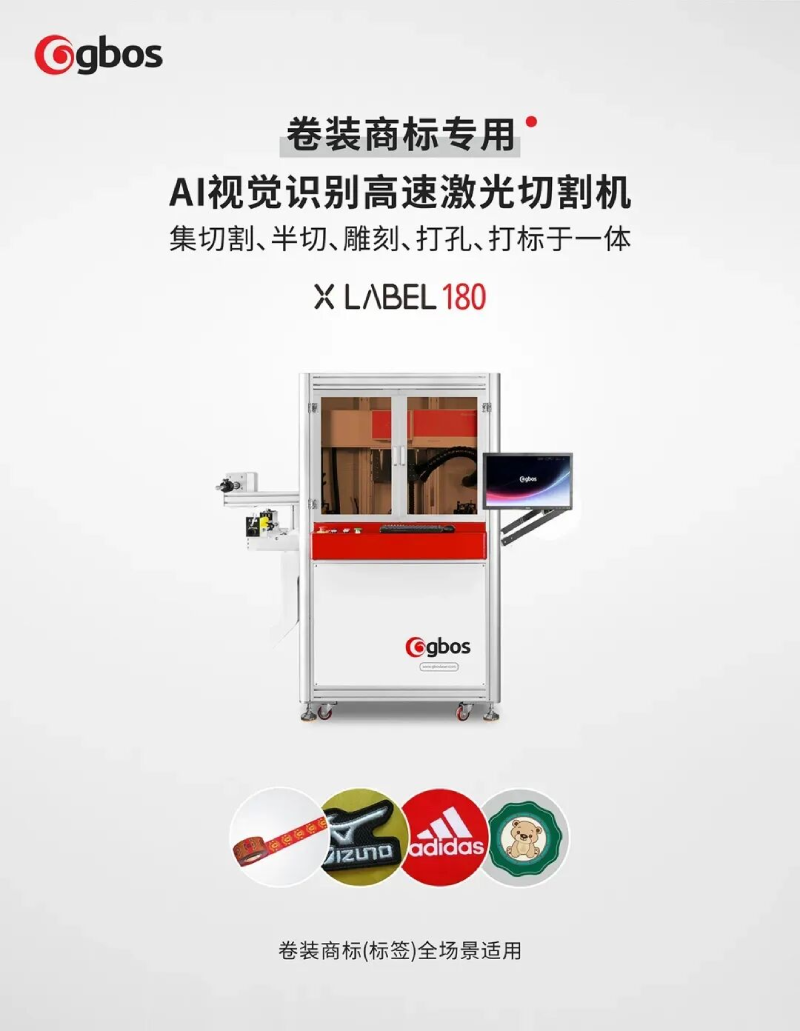
Developed for high-volume, roll-fed label and logo processing, the GBOS X LABEL180 Vision-Enabled High-Speed Laser Cutter integrates high-speed cutting, intelligent vision processing, and automated production management into one system.
Higher Efficiency, Fewer Machines
The X LABEL180 is designed to deliver production output comparable to more than ten traditional machines in specific high-volume applications.
Instead of expanding production by continuously adding machines and operators, manufacturers can consolidate workloads into a more efficient production setup. This helps shorten production cycles, reduce labor requirements, and respond more quickly to urgent or high-volume orders.
Flexible Processing for Complex Designs
Modern football jersey logos are rarely limited to simple rectangular labels.
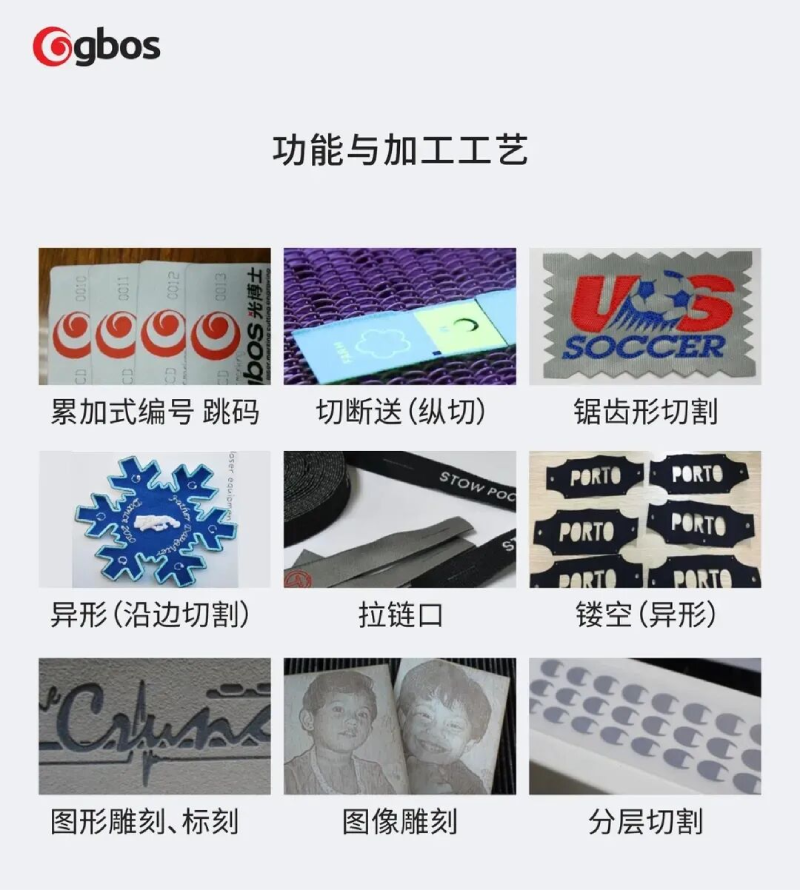
The X LABEL180 supports a wide range of logo geometries and processing requirements, including cut-outs, engraving, and multi-layer cutting. It can process woven labels, printed ribbons, and multi-layered materials while maintaining consistent cutting performance.
Its cumulative numbering and skip-code functions also support efficient batch management and product traceability, helping manufacturers manage large and diverse orders with greater control.
Cleaner Cutting, Better Finished Products
For labels and logos, appearance is critical. Even minor discoloration or contamination can affect the perceived quality of the finished product.
The X LABEL180 incorporates a four-dimensional smoke extraction system designed to remove smoke and fumes efficiently during laser processing. Combined with its fully enclosed, non-contact cutting process, the system helps reduce yellowing, blackening, and secondary contamination while creating a cleaner production environment.
Built for Stable, Continuous Production
High-speed production is only valuable when the equipment can maintain stable performance over time.
The X LABEL180 is built around a robust mechanical architecture designed for continuous industrial operation. Improved equipment stability helps reduce unexpected downtime, maintenance requirements, and the hidden costs associated with production interruptions.
03 | Intelligent Automation Is the New Competitive Advantage
The football jersey accessory industry is moving beyond simply increasing manpower and adding equipment. The real competition is increasingly about precision, efficiency, flexibility, and production stability.
Imagine two factories receiving the same logo order. Both have sufficient raw materials and skilled workers. Yet one factory consistently delivers faster, generates less waste, and requires less rework.
The difference may not be the order itself—it may be the production technology behind it.
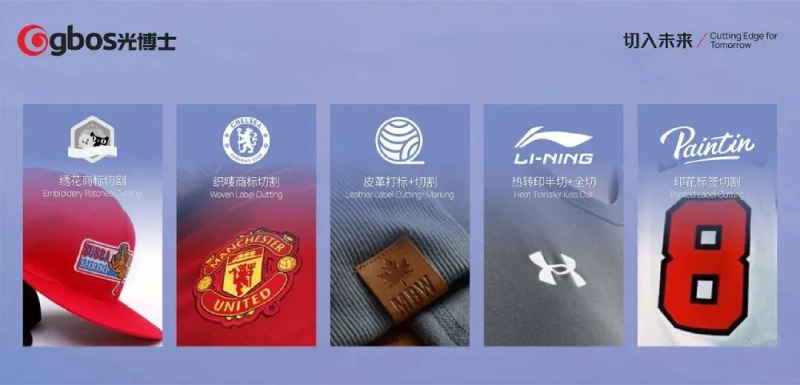
A high-performance roll-fed cutting system is therefore more than a machine for increasing speed. It can become a core part of a manufacturer’s production strategy, helping reduce material waste, handle complex designs, improve order consistency, and shorten lead times.

For football jersey manufacturers and label suppliers, every logo may be small in size, but its impact on brand perception is significant.
As brands continue to raise their expectations for detail and delivery, manufacturers need production systems that can keep pace.

GBOS continues to develop intelligent cutting and processing technologies for labels and flexible materials, helping manufacturers improve productivity, maintain consistent quality, and respond more efficiently to the evolving demands of the apparel industry.
 Address: No. 1 Liansheng Road, Hongmei Town, Dongguan City, Guangdong Province. CN
  Tel: +86 769 88990609
  Fax: +86 769 88990677
  Email: