


As jogging, fitness, and active lifestyles continue to gain popularity worldwide—and with major events such as the FIFA World Cup, FIFA U-17 World Cup, and Asian Games fueling enthusiasm for sports—the global athletic footwear market is entering a new phase of rapid growth.
Today’s consumers are no longer satisfied with footwear that simply performs well. They increasingly seek personalized products featuring stylish aesthetics, intricate pattern details, and premium material textures.

01 Explosive Growth in Sports Consumption Accelerates Transformation in Footwear Manufacturing
Changes in consumer demand are driving innovation throughout the footwear manufacturing industry.
Brands are now prioritizing rapid product iteration and flexible, small-batch production—bringing “fast fashion” concepts into footwear manufacturing. At the same time, OEM factories face growing pressure to improve quality consistency, control costs, and increase production efficiency.
As a result, competition within the footwear industry has evolved far beyond production capacity alone. Manufacturers must now compete across multiple dimensions, including efficiency, cost control, innovation, craftsmanship, and sustainability.

The companies that can efficiently mass-produce complex designs, reduce material waste, and maintain stable product quality will gain a decisive competitive advantage—breaking free from homogenized competition and capturing emerging market opportunities.
02 The Industry’s Core Challenge: Outdated Cutting Methods
Among all stages of footwear manufacturing, cutting is one of the most critical processes. It directly affects product quality, material utilization, and overall production efficiency. Yet, for many factories, it remains a major operational bottleneck.
Traditional cutting equipment still relies heavily on manual operation and visual alignment, making it increasingly unable to meet the demands of modern footwear production.
When processing materials such as same-color mesh fabrics, logo-printed textiles, digitally printed patterns, or irregular graphics, manual identification often leads to positioning inaccuracies, cutting deviations, and material waste.
In addition, conventional cutting machines typically support only basic cutting functions, lacking the precision and flexibility required for secondary or tertiary trimming processes. This limitation creates high rework rates and low production efficiency, especially when handling complex upper designs or multi-layer composite materials.
Traditional nesting methods also depend heavily on experienced technicians, increasing labor costs while limiting material utilization efficiency.

As orders increase, styles diversify, and delivery timelines become shorter, many footwear manufacturers face a frustrating paradox:
The more orders they receive, the more cautious they become about accepting new business.
Why?
Because profitability in footwear manufacturing no longer depends solely on sales volume—it depends on whether factories can achieve stable, efficient, and highly optimized cutting processes at scale.
03 GBOS Intelligent Cutting Solution: Redefining Smart Manufacturing Standards
To solve these challenges comprehensively, GBOS introduces the “SOKC Super Intelligent Cutting Mass Production Solution: VC9-1670T/N-4SCCD“—an advanced, production-ready intelligent cutting system designed specifically for modern footwear manufacturing.
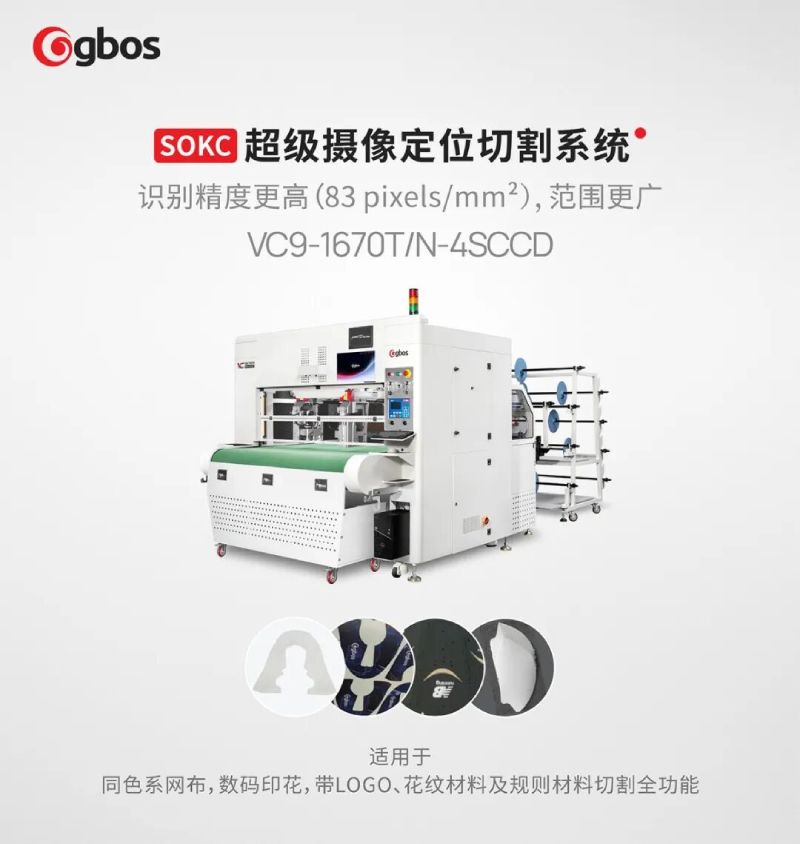
More than just a machine upgrade, this solution represents a complete transformation of the traditional cutting workflow, enabling footwear factories to move from manual, experience-based production toward standardized, AI-driven intelligent manufacturing.
Compared with conventional cutting equipment, the system delivers major improvements in precision, efficiency, flexibility, and cost control.
AI Vision Recognition for Complex Materials
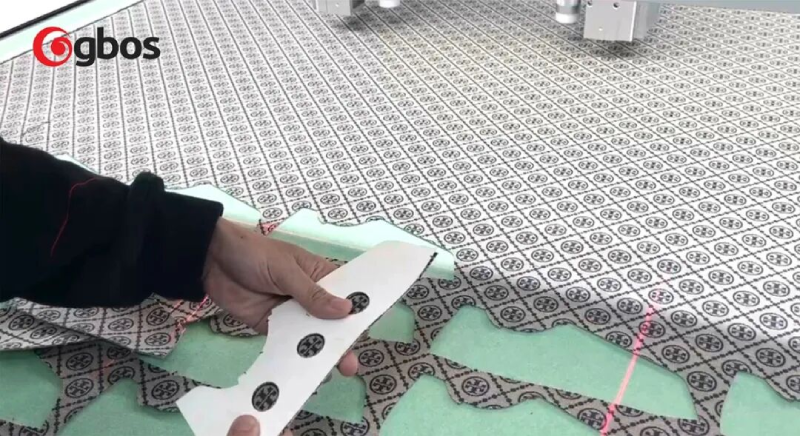
The system combines high-efficiency multi-layer cutting and standardized perforation with an advanced AI vision scan system capable of intelligent recognition and automatic positioning.
Even when processing difficult materials—such as same-color mesh fabrics, logo-printed textiles, digital prints, or irregular graphic patterns—the system can quickly identify patterns and achieve highly accurate automatic alignment, eliminating human positioning errors while preserving every design detail.
Advanced Precision Trimming Capabilities
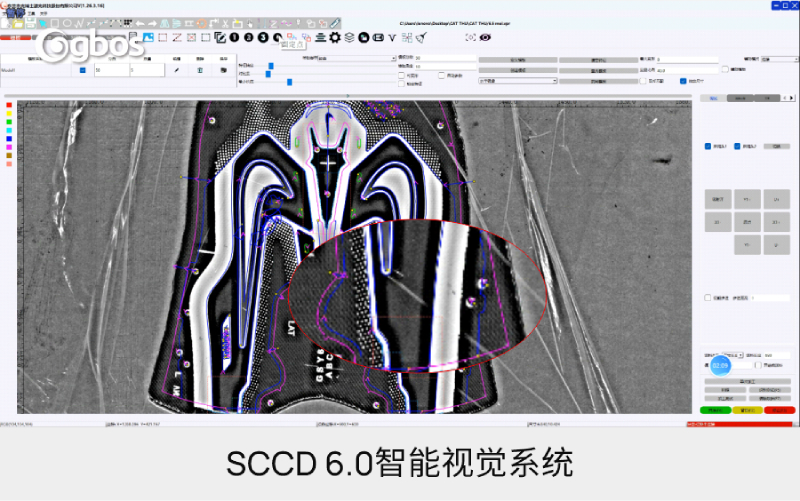
Beyond standard multi-layer cutting and perforation, the solution also supports high-precision secondary trimming for graphic and patterned materials.
When integrated with the upgraded SCCD 6.0 software platform, the system further enables tertiary trimming functions, allowing real-time contour adjustments for shoe uppers. This significantly improves material utilization while reducing production costs.
Intelligent Nesting for Maximum Material Efficiency
The built-in Intelligent Nesting System uses advanced optimization algorithms to automatically generate the most efficient cutting layouts.
This reduces dependence on highly experienced operators while maximizing material usage—even in demanding pattern-matching applications requiring strict alignment accuracy.
By minimizing waste and reducing labor dependency, the solution helps manufacturers lower operational costs, improve delivery performance, and enhance overall mass-production efficiency.
04 From Manual Production to AI-Driven Manufacturing
The GBOS intelligent cutting solution is not simply an incremental equipment improvement—it is a complete reconstruction of the footwear cutting process.
By integrating AI recognition, intelligent nesting, automated precision trimming, and standardized workflows, manufacturers can simultaneously improve:
● Product quality
● Production efficiency
● Cost management
● Process consistency
● Craftsmanship precision
This empowers footwear manufacturers to respond confidently to rapidly changing market demands while accelerating their transition toward digital and intelligent manufacturing.
05 Join GBOS at GISMA 2026 in Guangzhou
Want to experience next-generation intelligent footwear manufacturing firsthand?

From May 28–30, 2026, the Guangdong International Smart Footwear Machinery & Equipment Exhibition (GISMA) will take place at the Poly World Trade Center Expo Hall in Guangzhou.
At the exhibition, GBOS will present its complete range of intelligent digital cutting solutions through live demonstrations covering every key production process. A brand-new flagship model will also make its official debut, showcasing even more possibilities for the future of intelligent footwear manufacturing.
Exhibition Information
●Exhibition: Guangdong International Smart Footwear Machinery & Equipment Exhibition (GISMA)
●Dates: May 28–30, 2026
●Location: Poly World Trade Center Expo Hall, Guangzhou
●Booth: Hall 1, Booth 1E08
We warmly welcome footwear industry professionals and partners to visit the GBOS booth, experience intelligent manufacturing technologies firsthand, explore customized production solutions, and jointly shape the future of digital transformation in footwear manufacturing.
 Dirección: #B1, 8 DongCheng Section, Songshan Lake Avenue, DongCheng District,Dongguan, Guangdong, China
  Tel: +86 769 88990609
  Fax: +86 769 88990677
  Correo electrónico: