



As consumer preferences continue to diversify, leather materials are being increasingly used in automotive interiors, fashion bags and luggage, premium footwear, and upholstered furniture. This growing demand is creating new opportunities across the leather industry.
However, behind this market expansion lie common challenges: the rising cost of premium leather, significant material waste from traditional cutting methods, labor shortages, and fluctuating order volumes that make production capacity expansion both risky and expensive.

In such a competitive environment, conventional production models are no longer sufficient. For leather-processing enterprises seeking sustainable growth, embracing intelligent manufacturing and reshaping production logic through smart equipment has become an inevitable step.
01 A Solid Foundation: Where Hardware and Software Work Together
The performance of an intelligent cutting system begins with robust mechanical construction and advanced digital capabilities.
To address the industry’s evolving needs, GBOS has introduced the “KC1660T-4TX2-4P Four-Head Asynchronous Smart Oscillating Knife Cutter”, engineered to deliver both stability and flexibility.
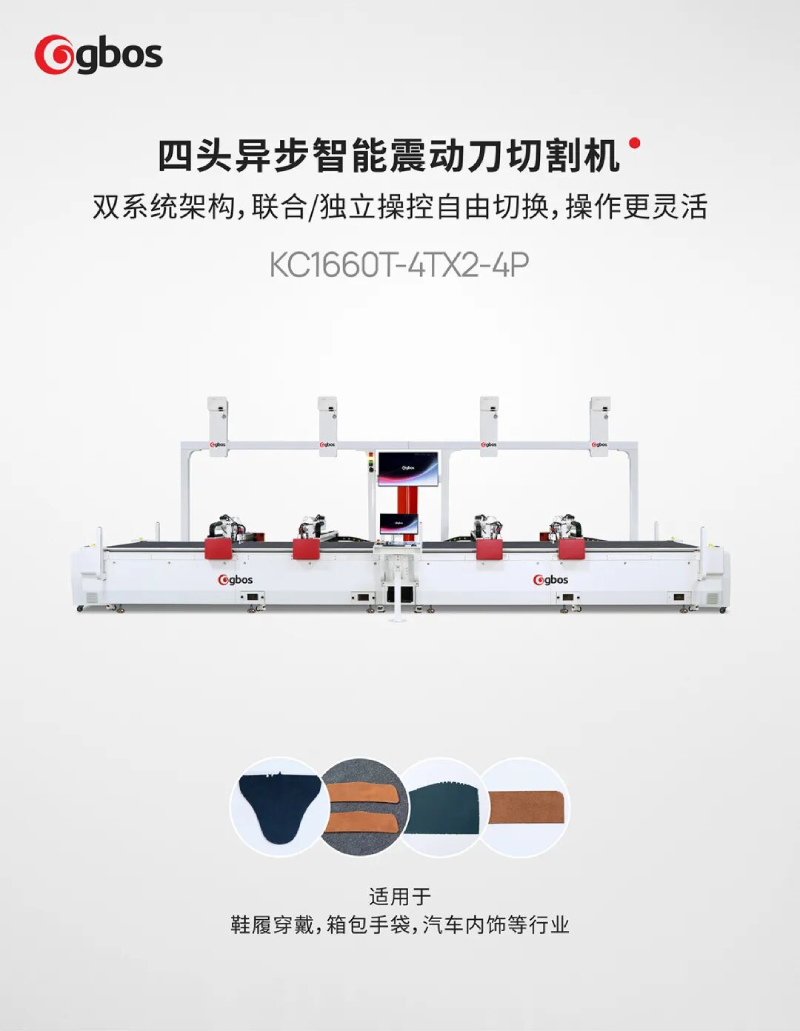
The machine features an integrated monolithic frame and precision-cast components, eliminating assembly-related accuracy deviations at the source. Its rigid structure ensures outstanding stability and precision, even during long periods of continuous operation.
To further improve material utilization, the machine can be equipped with a “Leather Data Reading Scanner”, which automatically reads leather information and instantly generates an optimized “Smart Nesting Layout”. This maximizes material usage and helps manufacturers mitigate the impact of rising raw material costs.
For higher levels of digitalization, the optional “AI-ITS1620 AI Leather Inspection System” enables full-lifecycle leather data management and fully complies with “SATRA” international standards. By digitizing inspection and quality assessment processes, manufacturers gain greater traceability and consistency throughout production.
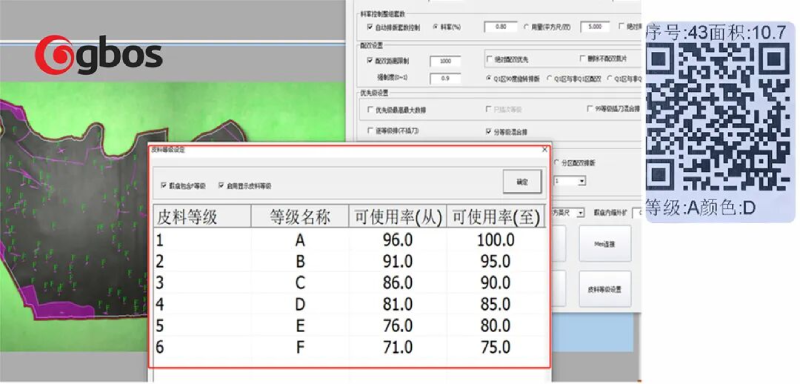
The system also features:
• Zoned vacuum adsorption, ensuring stable fixation of soft and easily shifting leather materials;
• An integrated processing platform, consolidating multiple operations into a single workflow;
• Visual projection preview, reducing setup time and minimizing trial-and-error adjustments.
In addition, its “dual-power drive system” supports both synchronous and independent head operation, allowing manufacturers to achieve an optimal balance between cutting precision, production efficiency, and operational flexibility.
02 Agile Evolution: Modular Scalability for Growing Production Demands
The leather market is inherently dynamic. Order volumes fluctuate, customer requirements evolve, and product portfolios continue to expand. This reality demands equipment that can adapt alongside business growth.
Designed with a modular architecture, the GBOS system offers exceptional scalability. Manufacturers can seamlessly upgrade from “four asynchronous cutting heads to six, eight, or even ten heads”, enabling production capacity to expand in line with market demand without requiring complete equipment replacement.
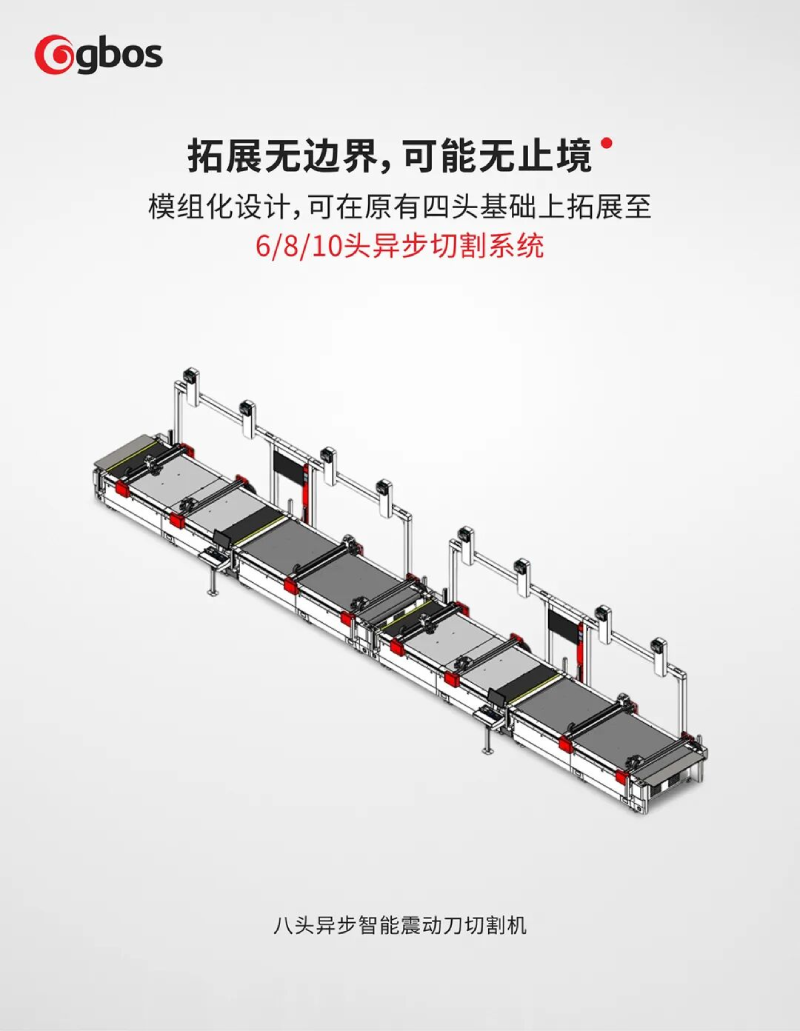
This flexible approach significantly reduces the capital investment associated with capacity expansion while preserving existing production resources.
The machine’s versatility also makes it suitable for all major leather application sectors, including:
• Footwear manufacturing;
• Fashion bags and luggage;
• Upholstered furniture;
• Automotive interior trim.
Whether processing small-batch customized orders or large-scale mass production, a single system can accommodate diverse manufacturing requirements, making it an ideal solution for factories of varying sizes and business models.
03 Industrial Upgrading: Beyond Equipment, Toward Competitive Transformation
Competition in today’s leather industry is no longer defined solely by product design or pricing. At its core, it is a comprehensive competition of “cost control, production efficiency, and responsiveness to market changes”.

Intelligent equipment is therefore much more than a tool for replacing labor. It is a strategic asset that enables enterprises to build long-term competitive advantages and achieve sustainable growth.
As the industry accelerates toward digitalization and intelligent manufacturing, technological transformation is no longer optional—it is essential. By leveraging advanced production technologies to eliminate operational bottlenecks, manufacturers can break through growth limitations and create new opportunities for development.
Rooted in real industry needs and driven by future-oriented innovation, GBOS remains committed to empowering leather manufacturers with cutting-edge intelligent solutions. Only by embracing technological advancement can enterprises navigate industrial transformation with confidence and move toward a broader, more promising future.
 Endereço: #B1, 8 DongCheng Section, Songshan Lake Avenue, DongCheng District, Dongguan, Guangdong, China
  Tel: +86 769 88990609
  Fax: +86 769 88990677
  E-mail: