


Consumer preferences are moving toward cleaner, more minimalist designs, making white fabrics and seamless materials increasingly common in apparel, functional linings, composite interlinings, sportswear, intimate apparel, and premium business-casual garments.
At the same time, seamless bonding technologies are raising the bar for cutting accuracy. Even small dimensional deviations, excessive heat, or edge damage during cutting can affect subsequent lamination and ultimately compromise the finished product.
For manufacturers, this creates a growing challenge: orders may be increasing, but profit margins are not necessarily following.
Rising material and labor costs, stricter quality requirements, aging equipment, and higher scrap and rework rates are putting increasing pressure on production efficiency. As a result, the cutting process has become a critical factor in both order fulfillment and profitability.
01 | The Hidden Costs of Cutting White & Seamless Materials
White and seamless materials present unique challenges that conventional cutting equipment may struggle to address.
Heat-Affected Edges Can Compromise Seamless Bonding
When seamless materials are cut, uncontrolled heat can create localized thermal deformation. Excessive or uneven heat may affect the dimensional stability of the material or adhesive layer, increasing the risk of separation and delamination during subsequent heat-press lamination.
For products that rely on precise bonding and clean edges, even minor dimensional inconsistencies can lead to rework or rejection.
White Materials Leave Little Room for Error
White and light-colored fabrics are particularly sensitive to thermal damage. During conventional laser cutting, concentrated heat can cause yellowing, discoloration, or charring along the cut edge.
Although these defects may appear minor, they can make finished components unacceptable—especially when visual quality is a critical requirement.
Manufacturers may then have to manually trim damaged edges or scrap entire batches, resulting in:
• Higher material consumption
• Increased labor costs
• More rework
• Lower production yield
• Higher cost per finished piece

Productivity Becomes Another Bottleneck
Production efficiency can also suffer when machines require frequent loading and unloading.
On single-station equipment, cutting must stop while operators remove finished pieces and prepare the next batch. During peak seasons, these interruptions can quickly accumulate into significant production losses.
At the same time, complicated parameter settings increase operator training requirements and leave more room for human error.
This creates a familiar manufacturing dilemma:
Slow down to protect quality, or increase speed and accept a higher risk of defects?
GBOS aims to eliminate this trade-off.
02 | GBOS Solutions for White & Seamless Materials
To address the specific challenges of white fabrics and seamless materials, GBOS has developed a dual-head interactive laser cutting solution built around three core principles:
“Precision thermal control + intelligent workstation design + simplified operation”
The result is a cutting solution designed to improve edge quality, dimensional consistency, production continuity, and material utilization.
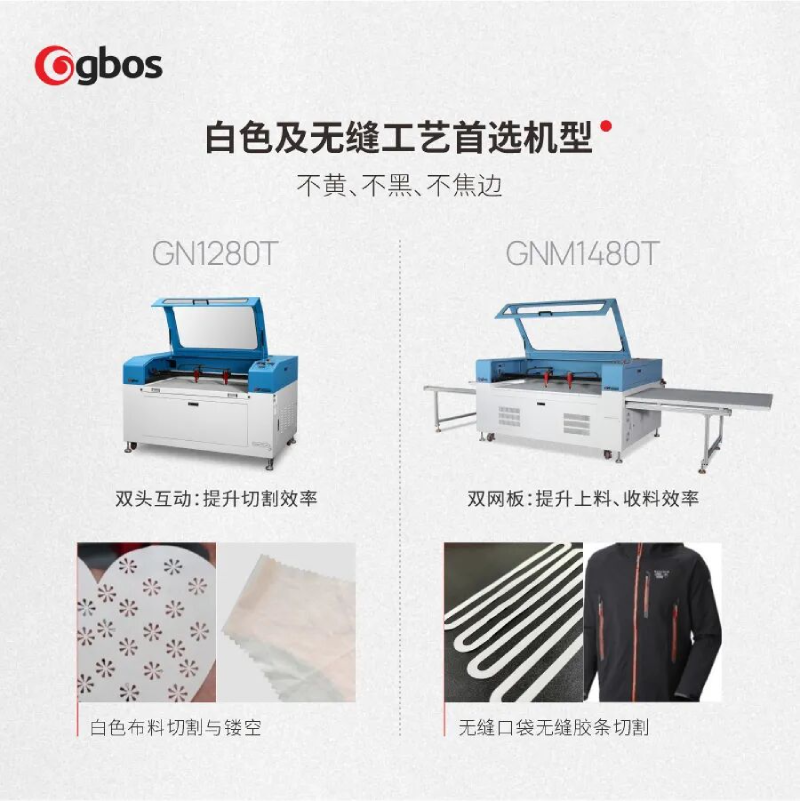
For SMEs & Prototyping: GN1280T
The GN1280T is designed for small- and medium-sized manufacturers, sampling departments, and workshops that require high-quality cutting without unnecessarily complex operation.
Dual-head cutting architecture
Two synchronized laser heads work within the same cutting area, increasing productivity while maintaining precise cutting control.
Optimized thermal-control optical system
The optical path is designed to distribute cutting heat more effectively, helping minimize yellowing, charring, and thermal deformation on ultra-thin white fabrics and elastic seamless materials. This can reduce the need for secondary edge trimming.
Intelligent DSP control interface
Key process parameters are clearly displayed and adjustable in real time, making machine operation easier to learn and helping reduce operator-related inconsistencies.
For perforated and irregular patterns, precise dimensional control also helps minimize potential stress on adhesive layers during subsequent heat-press lamination.
For High-Volume Production: GNM1480T
For manufacturers handling large orders and demanding production schedules, the **GNM1480T** takes the interactive cutting concept further.
Dual-head cutting + dual independent conveyor tables
While one table is cutting and unloading, the other can be loaded and positioned for the next job. This minimizes idle time between production cycles and creates a more continuous workflow.
For manufacturers facing urgent seasonal orders or high-volume production requirements, this architecture helps maximize machine utilization and maintain a stable production rhythm.
Optimized thermal dissipation and temperature control
The system is designed to manage heat during extended operation, helping maintain consistent edge quality and the original appearance of white materials.
This is particularly valuable when processing different white fabrics and multi-layer seamless composites, where stable thermal conditions are essential for maintaining yield and reducing scrap.
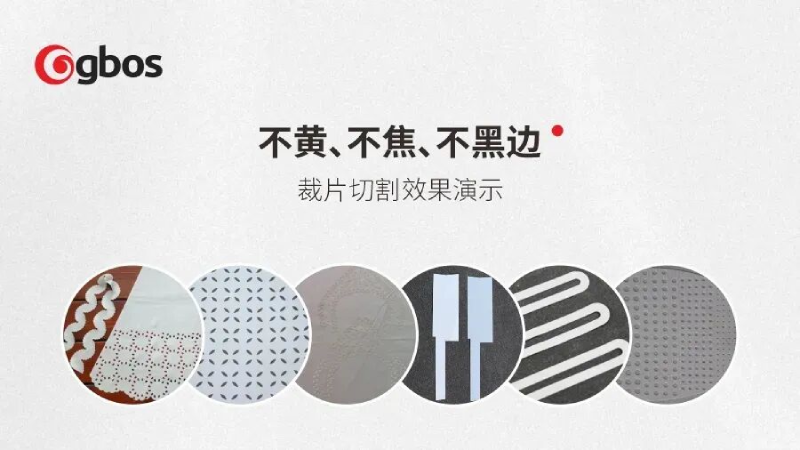
One Technical Foundation. Two Production Scenarios.
Although the GN1280T and GNM1480T are designed for different production environments, they share the same core philosophy:
• “Precision thermal management” helps protect material integrity and appearance.
• “Dual-head cutting technology” increases cutting efficiency and overall capacity.
• “Intelligent control systems” reduce operator-dependent variation.
• “Stable dimensional accuracy” helps support downstream bonding and lamination processes.
• “Continuous workflow design” helps manufacturers improve productivity without sacrificing quality.
The objective is simple: cut faster, maintain cleaner edges, reduce waste, and make every piece of material count.
03 | Equipment Evolution: Building Manufacturing Resilience
The era of relying on low labor costs and high-volume orders to maintain manufacturing margins is changing.
With raw material prices rising, competition becoming increasingly intense, and global brands imposing stricter quality standards, simply reducing labor or switching to cheaper materials is no longer enough.
Manufacturers need equipment that can address the specific challenges of the materials they process.
For white and seamless materials, that means controlling thermal impact, protecting edge quality, maintaining dimensional accuracy, and improving production continuity—all at the same time.

GBOS will continue developing specialized digital cutting solutions for different materials and production scenarios, helping manufacturers respond to increasingly demanding markets.
Because in a competitive manufacturing environment, every clean cut matters, every saved piece of material matters, and every improvement in yield contributes directly to profitability.
 주소: 광둥성 동관시 홍메이진 리안셩로 1호. CN
  전화: +86 769 88990609
  팩스: +86 769 88990677
  이메일:
이메일: