


The lingerie industry is undergoing a major transformation.
The market for sports bras and seamless bras continues to grow, while orders are becoming more fragmented and delivery cycles are getting shorter. Small-batch, multi-style production is gradually becoming the norm.

At the same time, consumers are demanding greater comfort, better shaping performance, and more functional designs. This is pushing manufacturers to work with increasingly diverse and complex fabric combinations.
For lingerie factories, production therefore needs to become more flexible than ever—while cost control, cutting accuracy, and quality consistency must remain stable.
01 Two Common Fabrics, One Critical Cutting Challenge
Lycra® and cotton are among the most widely used materials in lingerie manufacturing, but both can present significant challenges during cutting.
Lycra® is highly elastic. When multiple layers are stacked, the fabric can stretch and shift between layers. Even small dimensional deviations in the cut pieces can affect subsequent sewing and, in severe cases, result in an entire batch being rejected.
Cotton presents a different challenge. Its soft texture can make cutting more difficult when the blade is not sharp or stable enough. Frayed edges, material adhesion, and inconsistent cutting results may then lead to additional manual rework.
These challenges become even more noticeable as the number of fabric layers increases. Stable cutting performance and precise blade control are essential to maintaining consistent piece dimensions and clean edges.
Traditional cutting methods struggle to meet these requirements.
Single-layer cutting offers greater control but limits production efficiency. Manual cutting, meanwhile, depends heavily on operator experience and judgment, making it difficult to maintain consistent accuracy across large production volumes.

For lingerie manufacturers handling high-volume orders, achieving both cutting efficiency and precision can become a significant bottleneck.
And because cutting is the first major step in the production process, problems at this stage can quickly affect everything that follows—from sewing and assembly to final quality inspection.
In many factories, the problem is not a lack of orders. The real challenge is having enough cutting capacity to process those orders efficiently and consistently.
02 H3-T: Bringing Greater Stability to Multi-layer Cutting
The GBOS Multi-functional High-layer Precision Digital Cutting Table H3-T is designed to address these challenges through high-volume, high-precision multi-layer cutting.
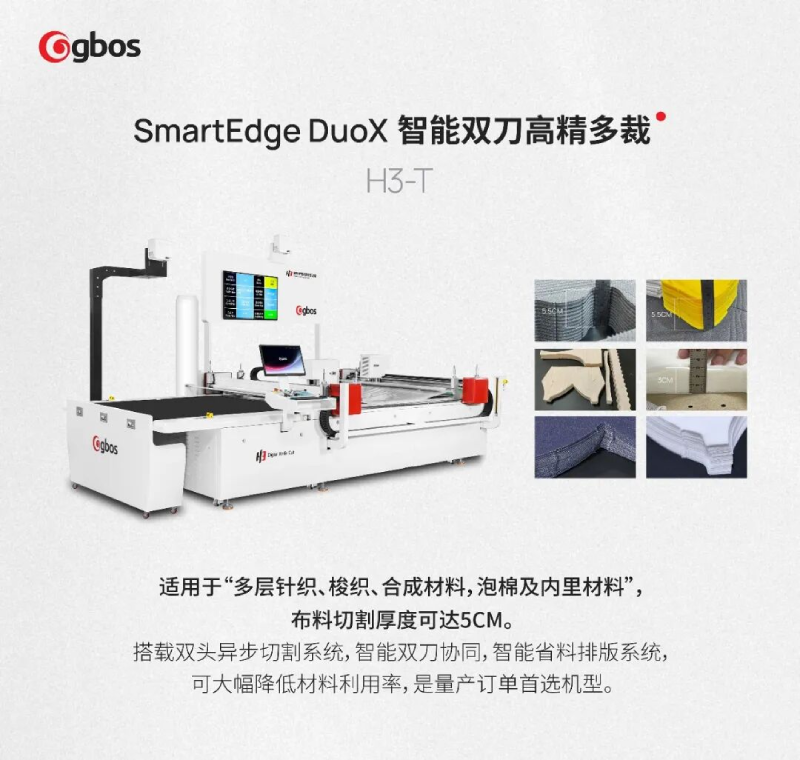
With a maximum cutting thickness of 5–6 cm, H3-T can handle stacked layers of highly elastic fabrics such as Lycra®, as well as cotton, knits, and woven fabrics.
Its Intelligent Nesting System automatically optimizes pattern placement to improve fabric utilization and reduce unnecessary material waste before cutting even begins.
For high-volume production, Dual-head Asynchronous Cutting Technology allows two cutting heads to operate independently and simultaneously without interfering with each other. This helps maintain consistent cutting efficiency even when processing large orders of more than 10,000 pieces.
More importantly, the system is designed to maintain stable piece dimensions and smooth cut edges throughout the cutting process. This provides a more consistent foundation for subsequent sewing and assembly.
Multi-layer stacking, highly elastic fabrics, and large production volumes create a combination of challenges that can be difficult for conventional cutting equipment to handle.
This is precisely where H3-T is designed to deliver its value.
03 The Real Value of Cutting Equipment Is Measured on the Production Floor
The lingerie industry is moving from traditional manufacturing toward more intelligent and flexible production.
But intelligent manufacturing is not simply about adopting new technology. Its value is ultimately reflected in everyday production: more consistent cutting accuracy, better material utilization, higher production efficiency, and more reliable delivery performance.
For lingerie factories, the real return on investment comes from being able to process orders faster, reduce material and labor-related costs, and maintain stable quality even as production becomes more complex.
Turning difficult-to-cut fabrics into standardized cutting outputs is an important step toward achieving this goal. When cutting becomes more stable and predictable, the entire downstream production process becomes easier to manage.

With more than two decades of experience in flexible manufacturing, GBOS has remained focused on empowering manufacturers through technology. By improving cutting efficiency, precision, and production stability, GBOS helps manufacturers turn equipment upgrades into tangible improvements on the factory floor.
 Adres: Liansheng Caddesi No. 1, Hongmei Kasabası, Dongguan Şehri, Guangdong Eyaleti. CN
  Tel: +86 769 88990609
  Faks: +86 769 88990677
  E-posta: